Tag: ICC U19 Men’s Cricket World Cup 2024

Anrich Nortje: The legacy of the U19 Men’s CWC 2024 is that it will continue to inspire more future stars for years to come

The last few weeks, which I spent being the event ambassador for the ICC U19 Men’s Cricket World Cup, was an exhilarating experience, especially watching the young talent on show in this special tournament.

It was nerve-racking to do commentary and work behind the mic – I haven’t been that nervous in a while – but it was great to see how everyone worked together to make it a successful production. I was immersed in the World Cup and I enjoyed every moment of it.

The tournament benefited enormously from a vibrant atmosphere at each of the five venues, and this will no doubt have helped bring the best out of the exceptional talent and formidable teams on display. Australia emerged as the deserving winners, but before delving into their triumph, it’s essential to acknowledge how remarkable it is to organise such a significant event in such a short space of time. 

It will have taken a huge amount of work and I must give a lot of credit to the ICC and Cricket South Africa for making this tournament successful with such little time to prepare.

While we saw glimpses of brilliance from players throughout the tournament, I think the two semi-finals summed up how close some of the top teams were. It was pleasing to see these youngsters playing fearless cricket under this amount of pressure in front of packed crowds.

It’s hard to imagine what must go through the minds of the young fans watching on. It will have no doubt been an inspirational experience for a 10-year-old child. After all, it could be a dream for them to one day represent their country on this stage, a stepping stone to making it to a higher level.

Being on the ground, you couldn’t help but notice how the fans streamed through the gates in big numbers. On the grass banks, you saw a lot of families, even on weekdays. It was great to have parents deciding to bring their kids along to witness the action.

South Africa is a place that loves sport, especially cricket. An event like this brings people together, and it creates memorable experiences for families to cherish for a long time. 

When you see cricket happening in your country, in your own backyard rather than on TV, it just feels more realistic, more accessible. You see the young guys, you see the players, you see the opportunity that there is. And that makes it special. That’s what the tournament is about. 

On to the cricket itself, India and Australia were really impressive and deserved to be in the final. But, naturally, I always kept a close eye on South Africa, and I thought they were exceptional. Their semi-final against India was a high-quality game, and it could have gone either way. In all, the South African team can keep their head high – they were one of the top teams in the tournament, and they made all those fans who came down to watch them proud. 

After those closely-fought semi-finals, the final was perhaps a bit one-sided, but you could see the quality in Australia. They were the team with the most all-round strength, and it showed, especially in the final when they needed a big team contribution. They had four different fast bowlers who all bowled well, a dependable captain, and different players who all stepped up at different stages of the tournament. 

For instance, in the final, Harjas Singh contributed with the all-important half-century – he did not have the greatest of tournaments up until then, but he came good when it mattered. As a team, you don’t want to be relying on one or two players. The whole team needs to contribute, and Australia had more players who they could rely on than the other semi-finalists. And that’s the mark of a good team.

As a fast bowler, I always keep a particularly keen eye on that discipline, and I came away very impressed with the pace-bowling on display in the tournament. Many pacers made an impression in the tournament, particularly the Australian attack – I thought they complemented each other well. I’m not going to put pressure on the players by naming who stood out to me, however. All these players still have a long way to go.

Make no mistake, playing in this World Cup would have been an invaluable experience for every player who turned out for their countries in the last few weeks. They’d have all learnt so many things; what you need to do at certain stages in matches, how you need to react when the pressure is on – these are things you can only learn from playing high-pressure tournaments. 

I didn’t have that till much later in my journey as I didn’t transition to the senior team through the U19 World Cup route. After not making the squad, I tried as hard as I could to reach every other level there was. And I was a better player for it when I finally got my breakthrough at senior level. That’s a valuable reminder to everyone – the work doesn’t stop. The journey has just begun.

It’s also, of course, important to savour the good moments. So I’d urge all the players to take some time to reflect on the last few weeks – it’s a great honour and a massive step in your career to make the jump into an international U19 team. After that, just keep on doing what you’ve been doing. You don’t have to change things to be the best version of yourself. 

Keep on doing what you’ve been doing, and hopefully, I’ll play with and against some of you soon at international level

ICC reveals U19 Men’s Cricket World Cup 2024 Team of the Tournament

Future stars hailing from five different nations including newly-crowned champions Australia comprise the ICC U19 Men’s Cricket World Cup 2024 Team of the Tournament, announced today by the International Cricket Council.

Australia captain Hugh Weibgen is given the honour of leading out the star-studded lineup, chosen by an esteemed panel of media, broadcast and ICC representatives.

India enjoyed a resounding campaign leading up to Sunday’s final, and mark their impressive tournament with four names in the team. Champions Australia have three players included, South Africa have two names – including the Player of the Tournament Kwena Maphaka – while the West Indies and Pakistan each have one player feature.

The selection panel consisted of commentary representatives Ian Bishop, Melinda Farrell and Abhinav Mukund, media representative Telford Vice, and ICC Head of Events, Chris Tetley.

The Team of the Tournament for the ICC U19 Men’s Cricket World Cup (in batting order):

  1. Lhuan-dre Pretorius (SA) (wk) – 287 runs at 57.40
  2. Harry Dixon (AUS) – 309 runs at 44.14
  3. Musheer Khan (IND) – 360 runs at 60.00
  4. Hugh Weibgen (AUS) (captain) – 304 runs at 50.66
  5. Uday Saharan (IND) – 397 runs at 56.71
  6. Sachin Dhas (IND) – 303 runs at 60.60
  7. Nathan Edward (WI) – 101 runs at 50.50 and 11 wickets at 17.81
  8. Callum Vidler (AUS) – 14 wickets at 11.71
  9. Ubaid Shah (PAK) – 18 wickets at 12.38
  10. Kwena Maphaka (SA) – 21 wickets at 9.71
  11. Saumy Pandey (IND) – 18 wickets at 10.27

and

  1. Jamie Dunk (SCO) – 263 runs at 65.75

South Africa’s Pretorius takes the gloves for this Team of the Tournament, and also heads up the batting order, after a series of impressive and explosive displays in the Proteas surge to the semi-final.

The wicketkeeper batter hit three half-centuries towards the back end of the tournament, including an eye-catching 76 in the semi-final against India, and will be remembered for contributing heavily to his side’s fast starts, ending the U19 Men’s CWC with a strike rate of 94.09.

Australia’s Harry Dixon partners him atop the order after a superb tournament and some invaluable contributions in the knockout stages. Dixon remained resolute in the semi-final and final despite the challenges posed by bowling attacks of Pakistan and India, registering important runs atop the order in both, as well as their emphatic win over England in the Super Six stage.

India’s Musheer Khan takes the number three spot as the only batter to register two centuries during the competition. Despite a subdued end to the tournament, Musheer displayed plenty of early promise, featuring a wide array of attacking shots, as well as an ability to pick up wickets with his probing left-arm spin.

Captain Weibgen was instrumental to Australia’s fourth U19 Men’s CWC title, providing valuable runs and making intelligent on-field decisions that sparked another successful campaign. After a sensational match-winning century against rivals England on a difficult Kimberley pitch in the Super Six stage, Weibgen continued to grow as a player and leader, eventually sealing the deal with victory in Benoni inspired by his decision at the toss and with team selection.

Top run-scorer for the event, Uday Saharan played a pivotal role in India’s dominance through to the final. Scoring consistently throughout the event and registering a century against Nepal, Saharan saved his best performance for the thrilling semi-final against South Africa, dragging India back from the brink of elimination with a vital 81 runs to seal their spot in the final.

Saharan’s primary ally that day was Sachin Dhas, and the composed right-hander also earns a place in the Team of the Tournament for his ability to relieve pressure situations, and the innovative and aggressive strokeplay that charactised India’s wins over Nepal (116 runs) and South Africa (96 runs).

The West Indies made a promising start to the tournament, and could have progressed through to the semi-finals had their all-or-nothing match against Australia not been washed out. All-rounder Nathan Edward was a standout performer for the side, in particular during their win against England in Potchefstroom, taking three wickets and hitting 49 in a high-pressure chase.

The four out and out bowlers in the side all found success in their respective sides.

Australia’s Callum Vidler enjoyed plenty of pace and bounce on the South African surfaces, and posed a constant threat to batters throughout the competition. He starred in wins over England and Sri Lanka before his efforts in the semis and final included prized wickets with the new ball.

Ubaid Shah was in scintillating form for Pakistan in the U19 Men’s CWC, spearheading their bowling attack and demonstrating lethal amounts of pace that produced vital wicket taking spells in his side’s wins over New Zealand (three for 30) and Bangladesh (five for 44) in their run to the semi-final.

Player of the Tournament Kwena Maphaka set the World Cup alight from day one. Searing pace and swing handed him his first of three five-wicket hauls in the dramatic win over West Indies on opening day, and the pacer never looked back, with stellar performances in wins over Zimbabwe and Sri Lanka.

Maphaka almost provided South Africa with another match-winning performance in the semi-final defeat against India, yet his pace, bounce and ability to take important wickets just saw the young Proteas fall short.

Maphaka ended the tournament with 21 wickets, leaving him at the summit of the wicket-taking charts.

Completing the lineup is India’s Saumy Pandey, whose left-arm spin threat yielded 18 wickets – the most by any spinner in the tournament. Twinned with a supreme ability to bowl economical spells, Pandey was inspirational in the early stages in Bloemfontein, highlighted by his performances in wins over Bangladesh (four for 24) and New Zealand (four for 19).

The twelfth player listed in the ICC Team of the Tournament is Scotland opening batter Jamie Dunk. So important in their journey to the World Cup through the Europe Qualifiers, Dunk adapted well to the World Cup environment, registering impressive half-centuries against West Indies (57), South Africa (90) and in the gripping play-off match against Namibia (76).

The ICC U19 Men’s Cricket World Cup 2024 – The tournament that had it all

After 23 days and 41 matches, it was Hugh Weibgen’s Australia who got their hands on the coveted ICC U19 Men’s Cricket World Cup 2024 trophy, beating five-time champions India in the final in Benoni.

Weibgen’s triumph places him in esteemed company with Geoff Parker, Cameron White, and Mitchell Marsh as captains who guided Australia to U19 Men’s CWC titles. This triumph marked the end of a 14-year U19 trophy drought for Australia.

Weibgen not only led by example with the bat but was praised for his tactical acumen during difficult moments in the tournament, including the brave decision to pick four seamers and bat first against India in the final in overcast conditions.

Australia posted a formidable total of 253/7 in 50 overs. Harjas Singh’s half-century, coupled with significant contributions from Harry Dixon, Weibgen, and Oliver Peake, played a pivotal role in Australia posting the highest score in U19 Men’s Cricket World Cup final history.

In response, the Australian pacers dominated the Indian batsmen, who had performed exceptionally well throughout the tournament. The pressure of the scoreboard eventually led to India falling short by 74 runs, securing Australia’s first victory over India in the tournament since 1998.

India’s woes in finals against Australia continue, the senior side having previously lost out to Australia in last year’s ICC World Test Championship Final and the ICC Men’s Cricket World Cup 2023.

How the tournament played out

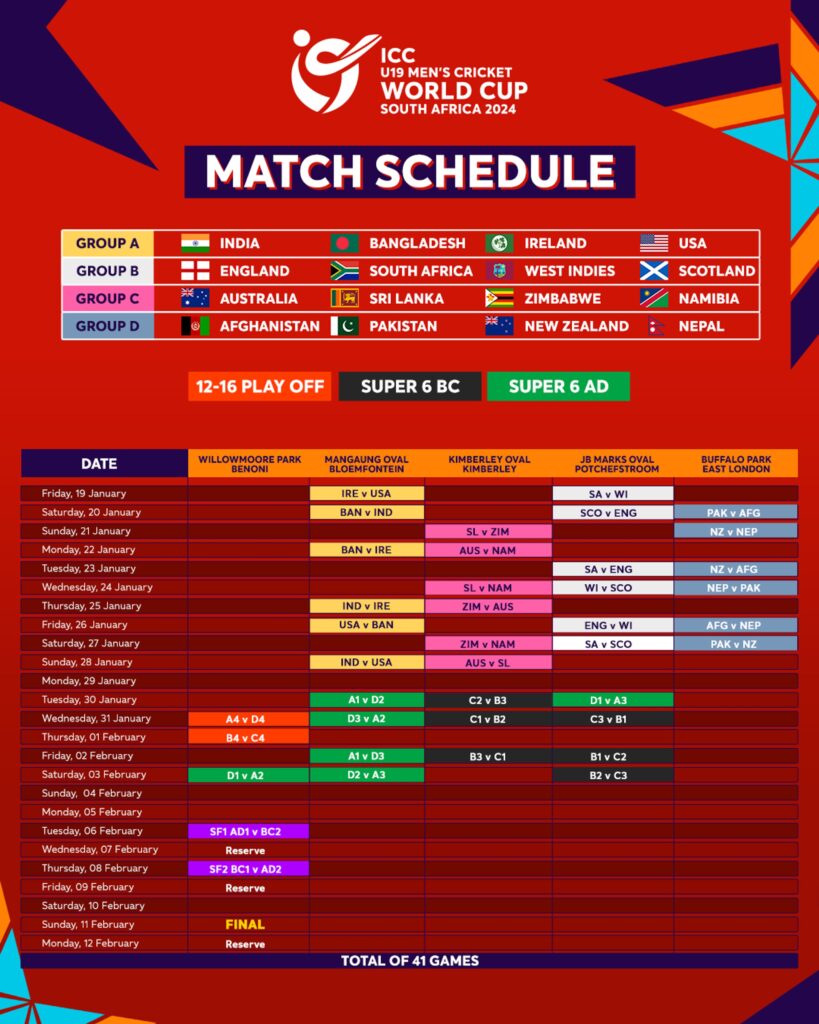
A total of 16 teams were divided into four groups of four, with three teams from each group progressing to the new Super Six stage.

India, Bangladesh and Ireland progressed from Group A while South Africa, England and West Indies moved forward from Group B.

While Australia, Sri Lanka and Zimbabwe qualified from Group C, it was Group D that witnessed a dramatic finale to the group stages, as Nepal edged out Afghanistan in a low-scoring thriller to join Pakistan and New Zealand in the Super Six.

The Super Six stage infused a renewed sense of excitement and energy into the tournament, elevating the stakes for the eagerly awaited semi-finals.

In Group 1, Bangladesh and Pakistan played out a humdinger in a low-scoring affair. In the end, it was Pakistan’s pacers who made the difference, defending 155 runs to take their side through to the semis.

Group 2 saw the vibrant West Indies crash out due to rain interruption in their virtual knockout against eventual champions Australia. Both teams needed a victory to progress, but the match concluded with no result, leading to Australia and West Indies sharing points.

Both semi-finals were closely contested matches that went right down to the wire.

For the first time in the tournament, the undefeated Indian team faced a stern test from the hosts South Africa. Despite a formidable effort by the South African pacers, led by the exceptional Kwena Maphaka, India – reduced to 32 for four in a chase of 245 – managed to secure victory, with skipper Saharan and Sachin Dhas putting together a pivotal partnership.

The second semi-final witnessed Australia initially cruising in their pursuit of 180 before Pakistan’s talented pace attack made a spirited comeback, with 15-year-old Ali Raza claiming four for 34. Australia still emerged victorious but by the slimmest margin of a one-wicket victory in the last over. 

The win gave them valuable momentum to help them secure their fourth U19 Men’s CWC title.


Stand-out moments


Kwena Maphaka vs Jewel Andrew: The Battle of the Best

The inaugural day of the U19 Men’s Cricket World Cup 2024 provided a tantalising preview of the tournament’s emerging talents. 

In the clash between South Africa and West Indies, Kwena Maphaka showcased his prowess by dismantling the Windies batting lineup with figures of five for 38. However, his efforts were countered by the determined Jewel Andrew, who nearly single-handedly guided his team to victory in a thrilling fightback.

Entering the crease with the scoreboard reading 52 for four while chasing 286, Andrew exhibited extraordinary poise, not only rescuing the team from a precarious situation but also steering them within reach of victory. Mixing caution with aggression, Andrew crafted a remarkable innings, tallying 130 runs off 96 deliveries, laced with 14 fours and three sixes.

Windies were 36 runs away from victory when Andrew fell, extinguishing West Indies’ hopes of securing a victory. South Africa ultimately won by 31 runs.


Steve Stolk shatters records

It wasn’t just the hosts’ bowling that shone in the tournament, with Steve Stolk leaving an indelible mark with his batting prowess.

Having succumbed to their first defeat of the tournament against England in the previous game, South Africa bounced back with authority in their next, led by the fiery batting of Stolk.

Scotland put up a formidable total of 269 and the pressure was on South Africa. However, Stolk’s eye-catching strokeplay eventually made light work of the chase. 

Scotland were blown away in the early exchange as Stolk created history by smashing the fastest fifty in U19 Men’s CWC history off just 13 balls, surpassing Rishabh Pant’s record off 18 balls. The onslaught didn’t halt there, as the opening batter neared a century before being adjudged LBW, falling just 14 runs short of a memorable hundred.

Stolk concluded his blistering innings having scored a remarkable 86 runs off 37 balls, comprising 7 fours and 8 sixes, boasting a staggering strike rate of 232.43.


The World Cup for thrillers

Despite not making it past the group stage, Afghanistan – the semi-finalists in the previous edition – gave the tournament two of the most memorable matches.

In a face-off against New Zealand, after being bowled out for 91, Afghanistan’s spinners weaved magic with the ball, turning what seemed like a straightforward victory for New Zealand into a nail-biting affair. 

New Zealand needed 10 runs with two wickets in hand and there was a run-out at the non-striker’s end to add to the drama.

The Black Caps eventually got across the line but Afghanistan’s spirited display earned plaudits from the cricketing fraternity.

Then, Afghanistan once again found themselves narrowly edged out, this time by Nepal, in a fiercely contested battle for the final Super Six spot from Group D. 

Defending a target of 146, Afghanistan’s spinners once more fought valiantly to keep their hopes alive. However, Nepal skipper, Dev Khanal, played a captain’s innings, scoring a splendid fifty to keep his team in contention.

When Khanal departed, Nepal had only two wickets in hand and still needed 19 runs for victory. It was Subash Bhandari who emerged as the hero, displaying composure to secure the win with a boundary, taking Nepal into the Super Six stage amid wild celebrations.

Despite not progressing beyond the group stage, Afghanistan, with their spirited performances, left a lasting mark on the U19 Men’s Cricket World Cup 2024. Their captivating matches against New Zealand and Nepal underlined the team’s resilience and fighting spirit.


The semi-final mayhem

Both the semi-finals of the U19 Men’s CWC 2024 lived up to their billing, going right down to the wire as all four teams fought for their chance at glory.

In the first semi-final, India won the toss and opted to field first for the first time. Prior to the semis, India had steamrolled all their opponents, with four of the five victories coming by a margin of over 100 runs.

Batting first, Lhuan-dre Pretorius and Richard Seletswane scored fifties and laid the foundation for a final flourish from Juan James and Tristan Luus, setting India a challenging target of 245.

Kwena Maphaka and Luus wreaked havoc with an outstanding exhibition of pace and swing bowling. At 32for four, India were staring at defeat when Uday Saharan and Sachin Dhas bailed them out of trouble with a 171-run partnership.

India were cruising to victory with the two at the crease when Maphaka struck twice in his final spell, including the wicket of Dhas on 96 to bring South Africa back into the contest.

Despite the setback, Saharan remained resolute at the other end and nearly guided India across the finish line. Unfortunately, he was run out in the penultimate over, but Raj Limbani stepped up, scoring the winning runs and securing India’s place in the final with two wickets and seven balls to spare.

The second semi-final clash between Australia and Pakistan produced perhaps the most blockbuster finish in the tournament.

Tom Straker wreaked havoc on the Pakistan batting line-up, reducing them to 79 for five before Azan Awais and Arafat Minhas anchored Pakistan’s innings with solid half-centuries to rescue them from a dire situation to 179.

What looked like a routine chase for Australia with a 33-run opening stand took a dramatic turn when Ali Raza bowled an inspired spell to turn the game on its head.

At 102 for five, the partnership of Oliver Peake and Tom Campbell took the team closer to victory before another collapse meant Australia fell to 164 for nine, still needing 16 runs.

In a heart-pounding climax, an inside edge from Raf MacMillan’s bat found its way to the boundary, eluding the desperate dive of Ubaid Shah as Australia sealed victory with just a wicket and five balls remaining.


Future stars

The U19 Men’s Cricket World Cup 2024 was the stomping ground for future generation of superstars with none more prominent than the Player of the Tournament Kwena Maphaka, who finished the tournament with 21 wickets, which included three five-wicket hauls.

Having played the previous edition as well, Maphaka finished with 28 scalps in total in U19 Men’s Cricket World Cups, tied with Zimbabwe’s Wessly Madhevere for most wickets in the tournament’s history.

Among the other pacers, Ubaid Shah, brother of Naseem Shah, gave a glimpse of the fast-bowling riches that continue to come out of Pakistan. With a combination of pace and swing that bewildered batters, Shah ended the tournament as the joint second-highest wicket-taker, accumulating an impressive tally of 18 scalps.

Australia’s pace bowling duo, Callum Vidler and Tom Straker played pivotal roles in the team’s title triumph, securing 13 and 14 wickets respectively. Vidler consistently posed a threat throughout the tournament, while Straker delivered a standout performance in the semi-final against Pakistan, finishing with figures of 6/24, surpassing Kagiso Rabada’s 6/25 for the best figures in a U19 Men’s CWC semi-final or final.

In a tournament largely dominated by pacers, India’s Saumy Pandey stood out as the sole spinner in the top five wicket-takers, sharing the second spot with Ubaid.

Among the batters, India captain Uday Saharan demonstrated the significance of composure in the dynamic realm of modern batting. Leading by example, he emerged as the leading run-scorer in the tournament with 397 runs, second only to Cameron White’s record of 423 in 2002.

In Musheer Khan, India might have found a brilliant batting all-rounder who can do damage both with the bat and ball. The second-highest run-getter behind Saharan, Musheer lit up the tournament with two centuries. With ball in hand, Musheer snared seven wickets in as many matches while bowling at a miserly economy of 3.63.

South Africa’s opening duo, Lhuan-dre Pretorius and Steve Stolk, dazzled with their aggressive batting, amassing 383 runs in six matches at a remarkable run rate of 8.09, creating early havoc for opposing teams on their journey to the semi-finals.

Australia’s Harry Dixon (309 runs) and captain Hugh Weibgen (304 runs) played pivotal roles in their team’s success, rescuing them from challenging situations on multiple occasions. Both featured among the top five highest run-scorers in the tournament and were the backbone of the title-winning batting lineup, including their crucial contributions in the final after an early breakthrough by India.

Australia clinch U19 Men’s Cricket World Cup crown with emphatic win over India

A dominant Australian side produced a superb all-round performance to secure their fourth ICC U19 Men’s Cricket World Cup crown, overcoming a formidable Indian side amid a vibrant final atmosphere at Willowmoore Park, Benoni on Sunday.

Led by Hugh Weibgen, Australia put in an exceptional display in the blockbuster finale, first posting the highest total ever recorded in a U19 Men’s CWC final and then executing a flawless display of bowling to dismantle India’s chase and secure the win by 79 runs.

Echoing the dominance of Pat Cummins and his senior counterparts in India a few months earlier, the young Aussie team secured their country’s first U19 title since Mitch Marsh led his team to victory in 2010.

India, who entered the tournament as defending champions, came off second best in what was their fifth consecutive final appearance in the U19 Men’s CWC.

Australia beat India by 79 runs

Australia 253/7 (50 overs) v India 174 (43.5 overs)

Australia won the toss and opted to bat under a cloudy sky in Benoni, and immediately got off to a fiery start. Harry Dixon stayed true to his burgeoning reputation as a David Warner replica by smashing Naman Tiwari for two fours and a swivelled pull for six in the second over, setting a blistering tone to the innings.

Raj Limbani was the first to strike from an Indian bowling outfit that had looked so dominant before the final, producing a brilliant inswinger to go through the defence of Sam Konstas. 

India introduced Saumy Pandey into the attack early, hoping to capitalize on any vulnerability Hugh Weibgen may have had against left-arm spin. The Australian skipper had been dismissed by left-arm spinners in three matches in the tournament prior to the final, and once by Pandey himself in a warm-up game in January.

But with the left-handed Dixon at the other end, the Aussie pair rotated strike easily against the Indian bowlers. Captain Uday Saharan turned to Musheer Khan, another left-arm spinner, to save Pandey’s overs, but the Webgen-Dixon partnership grew in confidence.

Though the introduction of spin momentarily slowed the scoring rate, it failed to yield wickets. Consequently, India reverted to pace after 11 successive overs of spin. It immediately reaped dividends. Tiwari induced a miscue from Weibgen, who drove straight to Musheer at backward point for 48.

Tiwari struck again in his next over, coaxing Dixon to lob one skyward with a well-disguised knuckle ball. With two quick wickets, India clawed their way back into contention, but Harjas Singh, who had previously struggled for form in the tournament, rose to the occasion with a crucial knock.

Teaming up with Ryan Hicks, Harjas anchored the Australian innings. With only two frontline quicks and the medium pace of Arshin Kulkarni at their disposal, India had little choice but to turn back to spin. However, the Aussie pair continued to accumulate runs with minimal risk.

Harjas opened up against Priyanshu Moliya, smashing him for a six and a four to assert his dominance on the bowling attack. He continued to take full toll on the spinners while Hicks found gaps to rotate the strike regularly.

The return of Limbani brought a wicket as the seamer trapped Hicks in front for 20 to break the partnership. Harjas continued unperturbed and completed a fine half-century – his first in the tournament – off 59 balls.

Pandey came back into the attack in the 38th over and trapped Harjas in front for 55 to give India a massive breakthrough. Musheer added another scalp, that of Raf MacMillan, in the 40th over and Australia slipped from 165/3 to 187/6.

Ollie Peake, coming in off a match-winning knock in the semi-finals, and Charlie Anderson built steadily before Limbani picked up his third wicket by trapping the latter in front in the 46th over. 

Peake remained unbeaten on 46 as Australia finished on 253, the highest total registered in a final of an U19 Men’s CWC. 

India had a daunting target ahead of them against a formidable pace attack. Callum Vidler started the second innings with a maiden over and Anderson, who had taken four wickets in the warm-up game against India, bowled another tight over with the new ball.

The mounting pressure gave way to the first wicket – Vidler had Kulkarni edging behind off a delivery that seamed away. Australia had their first strike, and it forced India into defensive mode with Adarsh Singh and Musheer Khan aiming to survive the new ball spells from the Aussie quicks.

Musheer showed early glimpses of promise with some fine shots, one of them a seamless punch down the ground for four. However, Mahli Beardman was introduced into the attack and the extra pace of an angled delivery into the right-hander exposed a gap in the batter’s defence.

India’s most reliable batter in the tournament, their skipper Uday Saharan, joined Adarsh in the middle with his side in huge trouble. The scoring rate hadn’t picked up, and they were staring at a big target with two wickets down already.

Saharan attempted to break free after a cautious start, but an aggressive drive resulted in a thick edge that found its way to Weibgen at backward point as Beardman struck for the second time in quick succession. 

India’s woes compounded as Sachin Dhas, the in-form batter, perished to MacMillan’s first ball. The off-spinner had Dhas caught behind for nine as India leaving India in dire straits at 68/4.

Adarsh found some company from Moliya and the stand got India into the nineties, but he top-edged a pull off Anderson and the resistance was broken.

Aravelly Avanish gave a return catch to MacMillan in the next over and India were six down.  

Sensing the increasing need to add runs, Adarsh attempted to accelerate his subdued innings, finding boundaries with a four and a six off Vidler. However, he ultimately nicked a short ball from Beardman to the ‘keeper, departing after a patient vigil at the crease, having scored 47.

Murugan Abhishek provided some late fireworks, but it was too little, too late for India, who were too far adrift from the target to mount a successful comeback. He finished on 42, miscuing a pull off Vidler’s final over. 

India were bowled out for 174, finishing second-best to an effective Australian unit that reserved their best performance for the final of the tournament. Beardman walked away with the Player of the Match award for what proved to be a match-winning spell of three for 15 from his seven overs.

Australian skipper Hugh Weibgen was proud of the effort from his team, especially the quicks, and also had a few words of encouragement for India.

“Our plan was to bat first and try and get runs on the board. We backed ourselves. A quality innings from Harjas [Singh]. Full credit to the coaches for sticking with him. They [pacers] can go far as a unit, they know their roles so well. I’ll be surprised if the four of them don’t go a long way in their careers. India are a class side, they dominated the whole tournament, just came out on the wrong side.”

Indian captain Uday Saharan commended the fighting spirit of his team and hoped to learn from the experience.

“I’m proud of the boys, they played very well and showed good fighting spirit. We played a few rash shots and didn’t spend time in the middle. We were prepared but couldn’t quite execute well. There are a lot of learnings from the tournament. We learnt a lot from the coaches and support staff and more importantly from the games themselves.”

India and Australia set to renew rivalry In U19 Men’s Cricket World Cup Final

The final of the ICC U19 Men’s Cricket World Cup 2024 will see India and Australia compete for silverware once again following a scintillating round of semi-final fixtures.

India confirmed their spot in the final after beating hosts South Africa by two wickets in a tense matchup on Tuesday. Chasing 245 for victory, India battled back from 32 for four to seal a memorable win thanks to a brilliant match-winning partnership between Sachin Dhas and captain Uday Saharan.

Thursday’s second semi-final also provided no shortage of drama, as Australia emerged victorious over Pakistan by one wicket in the final over of the contest. Having bowled out Pakistan for a seemingly below par total of 179, Australia stuttered in their chase before their middle and lower order formed crucial partnerships to help them edge home in thrilling fashion.

The highly anticipated final between the two sides will be hosted on Sunday 11 February at Willowmoore Park, Benoni, the same venue that staged both semi-finals, with the action commencing at 10h00 local time (SAST).

India and Australia both head into the final undefeated, having topped their respective groups in both the initial stage and the Super Six stage, and can boast some of the most exciting young talent on the planet.

Among the future stars that have impressed throughout the competition are skippers Uday Saharan of India and Hugh Weibgen of Australia, and both have their sights firmly set on lifting the coveted trophy on Sunday.

Speaking ahead of the final, India captain, Uday Saharan said: “As we approach the World Cup final, we carry the dreams of a billion hearts on our shoulders. Our journey has been a testament to our hard work, unity, and love for the game.

“In this final battle, we aim to create a legacy that inspires the next generation. It’s not just a game; it’s a chance to etch our names in history.

“Right from our first game, we have played with passion, determination, and a belief that we will get the coveted title home. In the final, against Australia, it is going to be no different as we go one step closer to defending the title successfully. Together, as one team, one nation, we march into the final, ready to seize our moment and make India proud.

“As a captain, I couldn’t have asked for anything more from my team as we stand at the cusp of creating history.”

Australia captain, Hugh Weibgen: “We’re really pleased to have made it through to the final after a close game against Pakistan and we can’t wait to take on India in Sunday’s final.

“The whole squad has done a terrific job throughout the tournament, and it would mean so much to us as a group to lift the trophy on Sunday. This is an opportunity to make our coaches as well as family and friends extremely proud. They have helped and supported us along the journey.

“India have obviously also had an outstanding tournament so far and are a class team. We’re expecting they will provide a challenge for us, and we are looking forward to it.”

These sides have met twice before in an ICC U19 Men’s Cricket World Cup final, with India having won on both previous occasions in 2012 and 2018.

Match Official appointments for Sunday’s final have also been confirmed, with Allahudien Palekar and Langton Rusere selected as the on-field umpires. Rashid Riaz will assume the role of TV umpire, with Roland Black acting as fourth umpire and Shaid Wadvalla as Match Referee.

Fans in Benoni wanting to see the U19 Men’s CWC 2024 champions being crowned can do so for free at Sunday’s final. The on-field action will be accompanied by a vibrant festival atmosphere, with live music and entertainment offerings that will enhance what promises to be a memorable showcase of cricket.

Fans in India will be able to watch the action unfold on Star Sports 1 and Disney+ Hotstar, with free-to-air coverage available on Doordarshan. In Australia, Prime Video will be providing live coverage across devices.

In the host nation South Africa, SuperSport Cricket will be presenting live coverage which also extends to Sub-Saharan Africa.

Criclife Max and Starzplay will provide coverage in the MENA region, while the match will be broadcast across Sky Sports Cricket and Sky Sports Main Event channels in the UK, with additional live coverage provided by Willow (USA & Canada), ESPN Caribbean (Caribbean) and on Sky Sport 2 in New Zealand.

In all other territories, broadcast of the final will be available live and free on ICC.tv.

Australia set up senior World Cup final repeat with dramatic one-wicket win over Pakistan

The ICC U19 Men’s Cricket World Cup 2024 final will see Australia facing off against India after the former edged Pakistan in a thrilling contest in Benoni.

If India’s narrow win over South Africa in the first semi-final was not enough, Benoni bore witness to another nail-biter as Australia beat Pakistan by one wicket to join India in the tournament final.

Reduced to nine wickets with 16 runs still required in a run-chase of 180, Pakistan had one foot in the final. However, Australia’s last-wicket pair held their nerve, defying the odds to clinch the match with just five balls remaining, leaving the spectators on the edge of their seats.

The win means that we will have a repeat of the ICC Men’s Cricket World Cup 2023 final with U19 World Cup defending champions India  going head to head against Australia.

Australia beat Pakistan by one wicket in Benoni

Pakistan 179 (48.5 overs) beat Australia 181/9 (49.1 overs)

Australia’s captain, Hugh Weibgen, won the toss and opted to put Pakistan in to bat in the crucial semi-final match of the 2024 edition of the ICC U19 Men’s Cricket World Cup, unleashing his pace bowlers on a fresh wicket.

Pakistan’s openers, Shamyl Hussain and Shahzaib Khan, started cautiously against the new ball from Mahli Beardman and Callum Vidler. However, the introduction of Tom Straker as the first change bowler brought immediate success for Australia.

In just his second over, Straker claimed the important wicket of Shamyl Hussain, who attempted an ambitious pull shot only to top-edge it to Oliver Peake, taking a fine catch at mid-on. Shortly after, Shahzaib’s watchful innings came to an end as he miscued a drive off Vidler to Hugh Weibgen at backward point, who held onto a splendid low catch.

With both openers dismissed within the Powerplay, Australia gained a strong foothold in the semi-final. Saad Baig and Azan Awais looked to rebuild for Pakistan and the former was saved by a dropped chance from Harry Dixon at first slip off Straker.

Baig’s luck didn’t last long, though, as Straker had the last laugh in the next over. The seamer found the left-hander’s edge again and this time Dixon hung on to the catch at slip to reduce Pakistan to 43 for three.

After 16 overs dominated by pace, Weibgen introduced spin into the attack. Raf MacMillan responded to his captain’s call by dismissing Ahmad Hassan with a well-pitched delivery that trapped him in front of the stumps.

MacMillan came close to claiming another wicket when Haroon Arshad narrowly survived a stumping chance. However, Beardman’s return to the attack proved fruitful as he dismissed Arshad with a delivery that skidded off the pitch and disturbed the off-stump.

Arafat Minhas joined Azan Awais, and together they revived Pakistan’s innings with a steady partnership. Awais reached his half-century off 83 balls, as the pair steadily increased the scoring rate between overs 31 to 40.

However, Straker ended their partnership by dismissing Awais for 52, caught behind by the wicketkeeper. With Awais departing, Pakistan found themselves in a precarious position at 133 for six, requiring a significant contribution from the lower order.

Minhas carried on unflustered, thumping Vidler off the back foot with a strong pull and bringing out the square cut against the spinner. He reached his half-century off 60 balls, cutting Tom Campbell in front of square for a boundary, but fell next ball when he attempted a loft over cover and sliced it to the deep fielder.

The tailenders couldn’t add too much to the total as Straker ran through them, cleaning up the last two off successive deliveries, to finish with six wickets, as many as he had managed in the entire tournament until today. 

Pakistan finished on 179, needing their bowlers to step up big-time to put them in the finals of the tournament. 

While Harry Dixon and Sam Konstas got Australia off to a slow, steady start, Pakistan made a roaring comeback after the Powerplay overs.

Fifteen-year-old Ali Raza cleaned up Konstas with a delivery that nipped back in sharply to hit the stumps. Weibgen smashed a full toss straight to short cover off Naveed Khan to depart for four and a massive mix-up between Harjas Singh and Dixon saw the end of the former. 

With three wickets falling quickly, Baig turned to strike bowler Ubaid Shah and the move worked. The dangerous Ryan Hicks was bowled off an inside edge for a golden duck as Australia slipped to a tense 59 for four. 

Dixon was joined by the left-handed Ollie Peake, who has had to bat only two times in the competition before this. The two left-handers went about rebuilding the innings as Pakistan looked to attack further. 

Dixon completed his half-century in the 24th over as Peake settled in at the other end. Minhas’ entry into the attack saw the back of Dixon. The left-arm spinner had the well-set Dixon cleaned up for 50 with a delivery that turned massively back into the batter.

Runs dried up as Minhas and Naveed Khan kept things pretty tight. Raza returned to the attack after Naveed was bowled out and almost instantly found a wicket. Tom Campbell’s edge was found but the ball raced over the keeper for a boundary, the first for Australia in nine overs.

Minhas, meanwhile, continued to bowl unchanged from his end and in his eighth over, the left-arm spinner struck again. Campbell was undone by an arm ball that skidded on with the angle and hit the stumps. 

With another threatening stand broken, Pakistan were back into the contest. Australia were still 34 runs away with four wickets left in the bank. Raza found MacMillan’s edge the very next over with the slip fielder diving to take a catch close to the ground. But confirmation for a clean catch wasn’t needed as the ball was over waist height and hence a no-ball.

Peake continued to build, unflustered by the chaos around him, but while on 49, he nicked a harmless Raza delivery, going down the leg-side, through to the wicketkeeper to leave Australia in a tricky position. They were still 25 runs away and Pakistan sensed a way back to win the contest.  

Raza added two more in his final over to put Pakistan on the brink of a sensational win, sending back Staker and Beardman to reduce Australia to nine down. 

MacMillan continued to fight though and got a lucky top edge over the keeper’s head for four in the 48th over with Australia needing less than 10 runs. 

Ubaid Shah almost trapped the lower-order batsman in front in the following over, but the umpire dismissed the appeal, judging the ball to be sliding down the leg-side. Vidler then played out the remaining deliveries, reducing the equation to just three runs needed off the last over.

In a nerve-wracking climax, on the first ball of the final over, MacMillan, who looked to punch off his back foot, got an inside edge and the ball raced through fine leg, securing Australia’s thrilling victory. 

Australia now have the opportunity to replicate the success of their senior team from three months ago when they face India in the final on Sunday, 11 February.

Australia skipper Hugh Weibgen stated that he had full confidence in Vidler and MacMillan to successfully finish the run-chase.

“Never in doubt [win]. We had full faith in Vids [Vidler] and Raf [MacMillan] to get the job done. There was quite a bit of emotion in the dressing room. I was quite tense and excited too. I still don’t know what really happened, but it was awesome.”

Pakistan skipper Saad Baig commended Ali Raza for his splendid spell, but remained composed despite the heartbreaking loss.

“It is difficult to be the losing team, but I felt we were 20-30 runs short. The boys played really well. Ali Raza was brilliant. Our bowling was pretty good throughout the tournament. Anyway, one team has to win, one has to lose, that’s the game.”

Resilience and clarity of thought – Shahzaib Khan’s mantra for chasing dreams

The weight of history is particularly heavy when you represent Pakistan.

There are always callbacks to the Cornered Tigers of ‘92 or the pace-bowling traditions of Wasim and Waqar, and in the case of the junior side in the ongoing ICC U19 Men’s Cricket World Cup 2024, the back-to-back title triumphs in 2004 and 2006.

It’s nearly two decades since Pakistan enjoyed success at this event. They came close in 2010 and 2014, reaching the finals both times, but the trophy still eludes them, even though superstars of the calibre of Babar Azam and Shaheen Shah Afridi emerged through the ranks. 

Shahzaib Khan is of course hoping to one day follow in the steps of those two, but his immediate aspirations are simple: “I can’t put into words the feeling of possibly winning the World Cup,” he tells ICC. “For the country and the team, the feeling will be unparalleled if we end up winning.”

Shahzaib has so far done his bit to that end – with an impressive tally of 260 runs in five matches, he sits proudly among the tournament’s top run-scorers. 

A high-stakes semi-final clash against Australia awaits on Thursday. With higher stakes comes more pressure, and add to it the weight of history that comes with representing Pakistan, there will likely be nerves.

But Shahzaib isn’t fazed. “We don’t take any pressure, we are playing our natural game,” he says. “We place equal importance on every match. We are putting our efforts into becoming champions this time around.”

That confidence is well founded. Pakistan’s record so far is unblemished, with the team going unbeaten in five matches to make it to the semi-finals. That said, it’s not been without challenges – their fortitude was put to the test in their last Super Six game against Bangladesh, a virtual quarter-final for both sides.

After being bowled out for 155, Pakistan were up against it. However, they showcased resilience with an inspired bowling performance and successfully defended the total, ultimately securing a thrilling victory by five runs.

“There was a bit of nerves when Bangladesh were chasing,” Shazaib admits. “It was a do-or-die match, a virtual knockout. We didn’t have many runs on board, but we knew that the wicket was difficult to bat on and that it would be challenging for Bangladesh to score those runs.

“We wanted to get early wickets and make the chase difficult for them. The pitch was such that it would have been difficult to score the runs despite it being a low score. 

“It was a tough match but I feel this was our best performance among the five matches.”

The unity the team displayed during that backs-to-the-wall performance was something Shahzaib speaks of proudly. “If you see our last game when the batting didn’t click, the bowlers put their hands up,” he says. “When the bowlers have an off day, the batters pull the team up.

“It’s a combination of these things that has led to our success. We play as a unit and we hope to continue doing so in the semi-final.”

Even if they don’t make it past the semi-finals, representing Pakistan has already been a dream come true for Shahzaib. The journey began in 2018, in the serene landscapes of Mansehra at the Junaid Khan Cricket Academy.

By the end of that year, Shahzaib had not only embraced the game but also made swift progress, playing in the U13 category and later transitioning to U16 with Khyber Pakhtunkhwa.

“When I started playing cricket, I wasn’t very aware of age-group cricket like U19 and U16 or much about the game,” he says. “But I was always determined to play for Pakistan – I didn’t know how but that was always the goal.

“Once I began (my journey) in 2018, I started to realise that I wanted to become a cricketer. But it was always in my mind that I wanted to represent the country.”

Shahzaib being left-handed, his cricketing idol comes as no surprise – the legendary Pakistani opener Saeed Anwar, who Shahzaib reveals was a big inspiration in how he shaped his approach to the game. Sri Lanka legend Kumar Sangakkara is another name-check when listing his inspirations.

Shahzaib’s rise has been rapid since he joined the age-group ranks, but it’s not all been smooth sailing. He was called up to the Pakistan U19 squad for the home series against Bangladesh in November 2022, but he struggled, scoring just 16 runs in three one-day games. “When I played against Bangladesh in Pakistan, I didn’t perform well.” 

However Shahzaib’s resilience came to the fore on the return tour in May 2023. He found his rhythm and scored an impressive 174 in the first four-day match, and soon clinched the Player of the Series title in both the four-day and one-day formats. 

Looking back, Shahzaib identifies this tour as the “turning point” in his career. “After that, I have played very well and have been part of all the series, including the Asia Cup and the World Cup,” he says.

There has been no turning back and his performances in the World Cup thus far are testament to his commitment to self-improvement.

For Shahzaib, the U19 Men’s CWC is the pinnacle for a young cricketer, a stage where dreams take flight. The importance of this esteemed event was heightened for Shahzaib when he marked his World Cup debut with a century against Afghanistan in the opener.

“It was a great feeling,” he says. “For a U19 player, there is no bigger event than the U19 World Cup. And for someone to score a hundred on their World Cup debut is a great honour. I was elated to score the century.

“I am happy with my performance in the five matches so far. But I will try to do better and score another hundred in the semi-final to help my team reach the final.”

When asked about his hopes beyond this tournament, Shahzaib Khan displayed that unwavering clarity yet again. “I want to perform to the best of my ability,” he says. “My dream is to play all three formats for the Pakistan senior team and have a long career.”

That weight of history sits lightly on young shoulders.

An exhilarating contest looms between Australia and Pakistan

The second semi-final of the ICC U19 Men’s Cricket World Cup will feature two sides who’ve had their fair share of ups and downs in the competition.

From the prism of results, Australia and Pakistan have done little wrong. Both sides remain undefeated in the competition and have overcome feisty opponents like England, New Zealand, and Bangladesh.

But their respective journeys to the knockout stage have been far from smooth. Both teams had to overcome challenging phases of play in adverse circumstances, something that held especially true for Pakistan in their Super Six encounters. 

While these jolts keep them battle-ready for the semi-finals, it also makes them aware of the areas that need improvement.

Australia and Pakistan are blessed with top-notch pace attacks and also have crafty spinners in their lineups. To add to that, their top-order batters have shown great form. 

With immense talent in their ranks and a propensity to play positive cricket, a must-win contest between these two line-ups has all the makings of a nail-biter.

How they have fared so far

Australia

Form guide (in the tournament): NR W W W W 

Hugh Weibgen’s side were grouped with Namibia, Zimbabwe and Sri Lanka. 

Led by Callum Vidler, the pacers wreaked havoc in their opening encounter against Namibia, bowling out the African side for 91. However, Namibia’s fast bowlers stood tall and had Australia in a spot of bother at 57/5. A patient knock from skipper Weibgen halted Namibia’s momentum and saw them through by four wickets.

A more rounded batting performance followed against Zimbabwe, where Harry Dixon’s 89 guided them to a strong total before Harkirat Bajwa’s 4/15 dismantled the chase. The final group clash against Sri Lanka saw a classy 77* from Ryan Hicks rescue the side after Australia’s top-order fell by the wayside at the start of the second Powerplay.

In their first Super Six game against England, the Australia top-order was once again among the runs, with Weibgen’s vibrant ton leading the charge. Their bowlers then pressed the advantage of scoreboard pressure in a rain-affected encounter and secured a massive win.

However, the batting slipped up once more against a charged-up West Indies in their final Super Six encounter yet a splendid century from Sam Konstas helped them to post a competitive total of 227/8. With Charlie Anderson’s early breakthroughs, the contest had all the makings of a thriller, but rain intervention meant the game ended without a result. Their undefeated run ensured that they topped Group 2 of the Super Six, and entered the semi-finals. 

 Pakistan

Form guide (in the tournament): W W W W W

Pakistan were placed in Group D along with Afghanistan, Nepal, and New Zealand.

The group games were relatively smooth sailing for Saad Baig’s team. Shahzaib Khan’s 106 set the tone for a substantial total against Afghanistan, even as Saad contributed with an attacking fifty. Pacers Ubaid Shah and Mohammad Zeeshan were relentless as Pakistan won the game by 181 runs.

A valiant effort from Nepal challenged them in their second game. Nepal batted out their 50 overs, before having Pakistan in a spot of bother at 104/4. A patient 63 from Azan Awais then pulled Pakistan through to victory in East London.

But Pakistan were back to their very best in the final group encounter against the Kiwis. Ubaid’s scintillating opening spell saw the back of the top order before Arafat Minhas ran through the tail with his three-wicket haul. An attacking 80* from Shahzaib won Pakistan the game by 10 wickets.

In the Super Six phase, after bowling out Ireland for a modest 181, Pakistan’s batting was tested. Ahmad Hassan’s 57* pulled them out of trouble this time, guiding them to a three-wicket win. 

A net run rate tussle brewed up in their final Super Six encounter against Bangladesh. Despite a sturdy start for Pakistan, Sheikh Jibon and Rohanat Doullah Borson bowled exceptionally well to clean up their subcontinental rivals for 155.

It took Ubaid’s 5/44 backed by some exceptional fielding to see Pakistan home by a five run margin in a low-scoring thriller. With eight points in their kitty, they finished second in Group 1, sitting behind India on the basis of run rate. 

Players to watch out for

Australia’s skipper Hugh Weibgen has also been their anchor in the tournament. He began the tournament with a brisk 39* from 43, which helped close out a risky chase against Namibia. 

A solid 68 from 69 balls assisted Harry Dixon in the second game versus Zimbabwe. He failed to get going in the third game but opened the Super Six with a stroke-filled 120 against England. He hit 15 fours in a knock that saw him bat for over three hours. This hundred laid the foundation for a massive Australian win.

Besides impessing with the bat, Weibgen has been an active captain on the field. He has been smart with his bowling changes and overall leadership.

Shahzaib Khan’s rock-solid presence at the top is a big plus for a mercurial Pakistan batting lineup. He was the Player of the Match in two of their group encounters, contributing with a hundred against Afghanistan, and an unbeaten half-century against New Zealand. 

The southpaw also ensured stable starts for Pakistan in low-scoring chases against Nepal and Bangladesh respectively. 

Given the recent troubles of the middle-order batters, Shahzaib’s innings at the top will be an important factor for Pakistan in the semi-final against a quality attack.

Callum Vidler’s pinpoint accuracy, pace and movement have seen him stand out for Australia. Despite missing a game and hardly bowling in the rain-affected encounter against West Indies, the bowler already has 11 wickets to his name. 

Eight of these wickets came in the form of match-winning four-wicket hauls against Namibia and England.

Along with Mahli Beardman and Charlie Anderson, Vidler can give Australia the early advantage on 6 February in Benoni.

The younger brother of Naseem Shah, Ubaid Shah stands joint second in the wicket-taking charts at the U19 Men’s CWC 2024, sitting behind South Africa speedster Kwena Maphaka. 

Beginning with a 4/26 against Afghanistan, the pacer hasn’t looked back. His skillful display with both the new and old ball has meant that the bowler has made an impact in all stages of the game and helped Pakistan come back into matches at crucial junctures.

This came to the fore against Bangladesh when Ubaid overcame the ignominy of having dropped a catch to pick the crucial wicket of Mohammad Shihab James in the very next over, changing the momentum of the match and helping Pakistan secure a famous win.

Predicted XI

Australia: Harry Dixon, Sam Konstas, Hugh Weibgen (c), Harjas Singh, Ryan Hicks (wk), Tom Campbell, Raf MacMillan, Harkirat Bajwa, Charlie Anderson, Mahli Beardman, Callum Vidler

Pakistan: Shamyl Hussain, Shahzaib Khan, Azan Awais, Saad Baig (c) (wk), Ahmad Hassan, Haroon Arshad, Arafat Minhas, Ali Asfand, Ubaid Shah, Mohammad Zeeshan, Ali Raza

Pace-loving Callum Vidler will let his skills do the talking in crunch semi-final

A decade ago, a wide-eyed eight-year-old watched awestruck as a fearsome Mitchell Johnson curled up his moustache, stared down the English batters and returned with a bucketload of wickets in the home Ashes. 

When Ryan Harris’ corker had Alastair Cook dismissed off the first ball of the innings in the Perth Test, that young boy made a decision. He wanted to steam in with the ball in hand, and just bowl fast.

Today Callum Vidler is doing just that. And doing it well. He’s making heads turn at the ICC U19 Men’s Cricket World Cup 2024, leading Australia’s wicket charts at the tournament. A large portion of Australia’s hopes of winning the title rests on him. 

“It’s hard not to be inspired to become a fast bowler watching that as a young kid,” Vidler tells ICC. 

“I thought to myself, ‘I want to do that’, you know? Bowl fast. Just run in and bowl fast. Watching them was my initial inspiration to take up cricket and fast bowling.”

Having been inspired to take up the ball by Johnson and Harris, Vidler went from backyard cricket through the ranks at Queensland, picking the brains of former Australia star Andy Bichel along the way, and more recently, Queensland’s Hamish Bennett. 

“They have been helping me keep it nice and simple, and bowl my best ball and back myself to deliver and hopefully change a game,” he says. 

Throughout his rise through age-group ranks, one thing remained constant – that love for fast bowling. It’s the “whole point” of taking up fast bowling, says the young Australian tearaway: Bowling fast.

“If anyone ever tells me to slow down, I am not listening to them,” he says. 

“Pace is my point of difference, my best attribute. I have also been learning to use it wisely, not having just pace, to swing the ball, using my variations and all. But if someone told me to slow down, it’s never working. The whole point is to bowl fast.”

Vidler says he clocked 143kph a few months before and believes he might be even faster now. He’s also picked up a few things additionally, like learning to ruffle up batters with the short ball every once in a while or pitching it right up with the new ball in pursuit of swing.

In the Super Six fixture against England, Vidler dismantled the opposition within the first ten overs of the chase by picking up four wickets. With overcast conditions in Kimberley, Vidler pitched the ball up to dismiss Theo Wylie and Ben McKinney, and then used the surprise short ball to send back Noah Thain and Hamza Sheikh. 

For someone who watched Johnson run in and bounce out batters with his intimidating pace, Vidler is a lot more subdued with his aggression. He aims to hit the right areas, attack the stumps and force errors with the odd variation in length. It’s what he did against England in what was his best performance in the tournament so far.

“In the first 10 overs I look to swing the ball and try and attack the stumps, but I also like using the bumper to surprise the batter and not get predictable with my length,” Vidler explains.

The youngster’s discipline is evident from his numbers too. No bowler in the ongoing tournament has a better bowling average than Vidler’s 7.81. The 11 wickets he has taken has come at a miserly economy of 3.55. 

Vidler, however, is quick to insist that that is a product of teamwork. “We have bowled our best when we have built pressure as a unit,” he says. 

“Tom Straker, Charlie Anderson haven’t quite been lucky in the wickets department, but they have built the pressure. And Mahli [Beardman] and myself have been able to be rewarded with a few wickets. Early on, we want to build pressure by attacking the stumps and keeping the heat on.”

Johnson and Harris might have inspired Vidler to take up fast bowing, but the 18-year-old models himself around Australia captain Pat Cummins – the nice guy who turns up and devours batters with immaculate skill. 

“In my younger teenage years, watching Pat Cummins, with his skill and pace, just being a class above everyone else, it’s inspired me and I definitely look up to him,” Vidler says.

He followed the ICC Men’s Cricket World Cup final in India where Cummins led his side to a memorable title triumph and hopes to do something similar in South Africa with the junior team. 

“Hopefully we can continue the track record of Australia doing great in ICC tournaments,” he says, adding that his immediate focus was on the semi-final against Pakistan. 

His impeccable discipline with the ball and maturity on the field extends beyond cricket – Vidler is keen to pursue further studies alongside cricket. “My mom encourages me to keep studying and I put my head down at the final exams in school.

“It’s been crazy to then come over here and potentially play cricket for a living. I will be going back to study in the University and playing cricket alongside. I just want a course to fall back on because the competition is heavy and as a fast bowler, injuries are always a concern. It’s just the way it is.”

On Thursday, however, everything else will take a back seat as he goes up against a strong Pakistan side. It is a tough clash against a team that has come through difficult matches in the tournament, but Vidler believes that Australia’s strength – their bond and unity as a group – will see them through. 

“You recall the first game against Namibia? We thought we had done pretty well with the ball,” he says. “Bowled them out for 90-odd runs. But then, in the run-chase, there were a bit of nerves. 

“We wanted to probably chase it down quickly, but then wickets started falling. That was possibly our only hiccup in the batting department so far this tournament. But we came through that as a group. It won’t happen again.”

The unity has been forged through tough tours and predicaments on and off the field. “Pretty much all of our squad members have known each other before. The tour of England – playing ODI and red-ball games against another U19 side helped a lot,” he says. 

“It was the first away tour for cricket for a lot of us. You don’t just learn on the field with these trips, a lot of the learning happens off the field too. It’s helped the team bond, looking out for each other and ourselves on the tour.”

If unity is Australia’s strength, Pakistan will rely on strong individuals who have stepped up time and again in the tournament. 

Vidler believes the pacer Ubaid Shah, in particular, will be a big threat. “Pakistan have an awesome pace attack,” Vidler says. “Ubaid, Naseem Shah’s brother, has been taking many wickets and stepping up in the big games. 

“There are a few other tall guys, it’s going to be a great battle. But we believe our quicks can out-do their fast bowlers. The battle between us and their batters will be an intriguing one.”

Does he want to send an early warning to the Pakistan batters? “We are very confident of winning the semis, but I am not going to send out any message to the Pakistan batters though,” Vidler laughs.

“We want to have a crack at their batters and stick to our skills. But no message. I don’t think I have any intimidation in me. I am not tall enough or scary enough. I just want to focus on my cricket.”

Given how the tournament has gone for him, that’s all he needs to do.

India punch ticket to final after thrilling win over hosts South Africa

The clash between unbeaten India and hosts South Africa lived up to its billing in the first semi-final of the ICC U19 Men’s Cricket World Cup 2024.

In a thrilling contest that went down to the wire, India secured a hard-fought victory, thanks to outstanding half-centuries from Uday Saharan and Sachin Dhas. 

Saharan’s team will now have the chance to defend their title in the final on Sunday, 11 February.

India now await the winner of the second semi-final match between Australia and Pakistan on Thursday to see who they will face in the title clash.

India beat South Africa by 2 wickets in Benoni

South Africa 244/7 (50) vs India 248/8 (48.5)

After losing four tosses in the first four games, Uday Saharan got it right for the second in a row and chose to field first. This was the first time that India bowled first in the tournament, having batted in each of their five victories so far.

Once again displaying his customary aggression in the tournament, South Africa opener Steve Stolk took charge early on, hitting two fours in the first three overs. He continued his onslaught with a maximum off Raj Limbani in the fifth but it was the Indian pacer who had the last laugh as Stolk’s attempted cut resulted in an edge straight into the hands of the wicketkeeper.

Lhuan-dre Pretorius kept the foot on the pedal thereafter, including a six and a four against Naman Tiwari in the 8th over. At the other end though, Limbani was on the money and accounted for the wicket of David Teeger for a duck, rattling the stumps with a peach of an inswinger.

Undeterred by the loss of two wickets, Pretorius continued playing attacking shots, and by the end of the Powerplay, South Africa were going close to a run-a-ball.

Saharan decided to introduce his spinners into play, effectively curbing South Africa’s scoring – only five boundaries were scored in the span of overs 11 to 30.

However, the partnership between Pretorius and Richard Seletswane ensured a steady flow of runs, with Pretorius reaching his half-century off 59 balls.

With the run-rate at less than four, the mounting pressure got to Pretorius, who tried to swat Musheer Khan over mid-wicket, but Murugan Abhishek showed brilliant reflexes to hang on to a stunning catch.

The Proteas saw an uptick in boundaries when Seletswane and Oliver Whitehead combined for a 45-run partnership. Just as the partnership started to look dangerous, Musheer struck with the final ball of his spell, dismissing Whitehead.

South Africa’s decision to delay the entry of the dangerous Dewan Marais proved unsuccessful as he holed out to Saumy Pandey inches inside the boundary for just 3.

Between the two wickets, Seletswane brought up a patient half-century but having taken 90 balls to get to the milestone, the youngster fell trying to make up for the scoring rate.

Having hit Limbani for two fours in the 45th over, Seletswane tried to take the attack to Naman Tiwari in the next, but was undone by a good catch by Priyanshu Moliya running in from the deep.

Juan James too departed after a solid 19-ball 24-run cameo, leaving South Africa at 221/7 with two overs to go.

Tristan Luus gave the innings some much-needed impetus in the final two overs, unleashing two sixes and a four to finish with an unbeaten 23 off 12 balls. 

As a result, South Africa set India a target of 245. This was the first time a team had got past the 200-run mark against India in the tournament so far.

In the chase, South Africa started brilliantly, courtesy Kwena Maphaka’s breakthrough on the first ball of the innings. Adarsh Singh found himself helpless against a sharp bouncer, awkwardly prodding it to the keeper.

The short ball proved to be India’s downfall once more as Tristan Luus’ accurately-directed bouncer outsmarted the dangerous Musheer Khan, sparking massive celebrations in the South African camp following the dismissal of the leading run-scorer in the tournament.

India had to be patient, waiting until the seventh over for their first boundary, which came in the form of a maximum from Arshin Kulkarni off Maphaka. Unfortunately, that solitary moment of joy for India was short-lived, as their difficulties continued to mount with Arshin falling victim to Luus in the final over of the Powerplay.

India’s situation worsened when Moliya, who had managed to strike a boundary off the first ball of Luus’ over, departed while attempting a loose drive.

Facing a daunting situation at 32/4, captain Saharan and Sachin Dhas orchestrated a remarkable rescue mission with an impressive partnership. With runs drying up, the pair mixed caution with aggression to keep the scoreboard ticking.

Particularly targeting the bowling of Riley Norton, Dhas showcased his prowess by striking three boundaries in a single over, reclaiming some control for India. While Saharan held firm at one end, Dhas assumed the role of the aggressor, racing to a half-century off 47 balls to keep the required run rate under 6.

Saharan quickly found his rhythm with a splendid boundary off James, not only marking the 100-run partnership for the fifth wicket but also propelling himself past Musheer Khan to claim the top spot on the tournament run-scoring charts.

The partnership between the two was a masterclass in innings building and chasing, as they milked singles relentlessly while putting the poor deliveries away for boundaries. 

The skipper too got in on the act, reaching his fifty off 88 balls with a boundary as India inched closer to victory.

Just as the required run rate got to a run-a-ball, Dhas and Saharan dispatched James for a six and four respectively to calm the nerves in the Indian camp.

But there was another twist as South Africa hit back when Maphaka was reintroduced into the attack. He got the better of Dhas with a well-disguised slower ball, the batter falling agonisingly short of a century on 96. 

The wicket brought about a lull in scoring, and the mounting pressure became palpable. Aravelly Avanish displayed nerves of steel by striking a crucial boundary off Norton on the final ball of the 46th over.

Maphaka bowled the 47th over and made a big difference off the last ball of the spell with the wicket of Avanish, with Norton taking a good catch in the deep. Two balls later, the game turned on its head again when Abhishek Murugan fell victim to poor running, being caught short of his crease by a direct hit from Marais.

The two wickets put the pressure back on India but a six from an unlikely source – Raj Limbani – shifted the equation, bringing it down to nine runs required off the last two overs.

Saharan put to rest any hopes of a South African comeback with four off the first ball of the penultimate over. In another twist to the game, Saharan was run out trying to scramble for the winning run. 

However, Limbani came in clutch again and struck a four off the final ball of the over to continue their unbeaten run and book their berth in the final.

The Player of the Match, India captain Uday Saharan, shared insights in the post-match presentation after bailing the team out of early trouble.

“I just believed in myself [after coming out to bat]. I knew it was a matter of one partnership and the game would be ours. I just kept telling myself repeatedly that I needed to bat till the end.”

Process-driven Musheer Khan is living in the moment ahead of heavyweight World Cup clash

Musheer Khan’s already had a remarkable ICC U19 Men’s Cricket World Cup 2024.

He is currently the leading run-scorer in the tournament, and with a semi-final against South Africa on Tuesday looming, has a chance to further cement his name alongside other luminaries of Indian cricket who walked the same path. 

One of those was Sarfaraz Khan, Musheer’s older brother, who played two editions of this tournament – in 2014 and 2016 – and was recently called up to the Indian Test squad for the series against England. 

Sarfaraz’s journey hasn’t been without its struggles, and in being able to pick the brains of someone who has done this before, Musheer feels privileged. He has learnt what he could while closely observing his brother’s career. His elder sibling is not just a source of inspiration now, but also a confidante.

“The first thing he told me was that there is no bigger pride than playing for India,” Musheer tells ICC when asked about his brother’s influence. “He told me to enjoy myself on the field and whenever I get a chance – be it with the bat or ball – you have to pull the team up in any situation and win the game.

“He told me to play with all my heart because you are representing the country. I have learnt a lot from Sarfaraz – right from how he bats to how he is always thinking about winning the game for his team, to how he builds his innings. 

“Even as he was knocking on the doors of the Indian team, his focus was always on scoring runs and on the process without worrying about the result. My focus too is on the process.”

His brother remains a big benchmark, but Musheer’s biggest source of inspiration – like almost every other cricketer hailing from Mumbai – is Sachin Tendulkar. 

That was evident during a standout moment against New Zealand when Musheer executed a remarkable upper-cut, prompting commentators to highlight the striking resemblance to the Little Master’s influence.

As Musheer continues to make a name for himself, he reflects on the beginnings of his journey, one that commenced at a tender age under the watchful eyes of his father.

“When I was younger, about 5-6 years old, my father would take me to the ground to play cricket,” he says. “Watching my brother play, I slowly started playing cricket

“There have been so many challenges in my journey so far. Right from childhood, there’s a very high level of competition, right from U14, U16 and now at U19.” 

Musheer credits his father for helping him navigate through the tricky patches. “My father always told me to keep working hard,” he says. “The challenges never stop, and you have to accept that as you keep moving ahead.”

Musheer has already played three first-class matches for Mumbai – something he said was the “turning point in my career so far” – and believes playing at the highest level in domestic cricket has helped him adapt strongly to the challenges that come with playing in a World Cup.  

Throughout the conversation, a theme emerges: The 18-year-old is always quick to credit the coaches, and underline his commitment to the team’s cause rather than individual feats. 

“The support staff has backed us to play fearlessly right from the start and back our natural playing style,” he says.

“Another thing that has helped us is that we play for each other in the team. If someone has a bad day, we don’t let it affect the player or the team. We are playing as a family and it shows on the field.”

Despite delivering standout performances in the tournament so far – including two centuries that have put him atop the run charts – Musheer says he won’t be happy until the World Cup is won.

“I am happy with my performances but I won’t be satisfied until we win the World Cup,” he says. “As far as being the highest run-getter, I don’t really want to think about it. 

“Since the start of the tournament, it was only about winning the World Cup and that’s what we are focussing on. I only want to do well for the team and take the results as they come.

“It would give us great happiness to bring the World Cup to India. But we know that it won’t come easily, and that we still have to work very hard to get our hands on the title.”

As the tournament enters a crucial phase, Musheer’s confidence is unwavering, despite the chance of facing a team that will be buoyed by home support. 

“There is no nervousness,” he says. “We view the semi-final as just another match, just as we did in the league stages and Super Six. We are not taking extra pressure.

“We are just looking to stick to our roles in the team, focusing on the process and the results will come. 

“It’s [about being defending champions] there at the back of our minds, that we have to win the World Cup, but we don’t let that get to us.

“We are preparing to the best of our abilities. We are taking this as a normal match and trying to give our best.”

It’s Musheer’s immediate dream to win this tournament. But the dreams go beyond that. Typically, he remains grounded, thanks to another piece of advice from his father. 

“There is a lot to achieve but my father has always told me to work hard and don’t think far too much about the future,” he says. “He tells me to stay in the present and focus on the upcoming matches. 

“When we think too much about the past or the future, we forget to be in the moment. That’s what our team is doing too.”

Profound words from a scintillating prospect

Kwena Maphaka, the bowling prodigy destined for bigger things

All it took for Kwena Maphaka to stamp his presence at the ICC U19 Men’s Cricket World Cup 2024 was two balls. Off his second delivery in the tournament, he bowled a searing, inswinging yorker that had West Indies opener Adrian Weir flummoxed.

What followed was an animated punch in the air and a big celebration – quite in contrast to the very mellow one he had planned with his elder brother Tetelo. For a few seconds, Maphaka was drawn into the moment, the adrenaline rush getting the better of him. He would end the day with a five-wicket haul, a feat he would go on to achieve twice more in the next few weeks. 

“That one [spell against West Indies] is probably closest to my heart,” Maphaka told ICC.  

“I just try to put out a good performance every game, but the West Indies one was the most memorable for me. It was the first game of the tournament, lots of nerves, a home World Cup, I thought my spell helped us get off to a really good start to the tournament … set the tone”

The tone was set the moment Maphaka’s sharp inswinger thudded into Weir’s boots. It was the culmination of what Maphaka considers the perfect plan – getting the new ball to swing as much as he can, and surprise the batter. 

Maphaka loves the inswinger. After his last Super Six game, the South African teenager, who’d cheekily said he hoped he was better than Jasprit Bumrah, watched the Indian quick’s unplayable yorker to Ollie Pope in the Test series in India. 

“I think he had all three stumps uprooted. It’s amazing,” Maphaka said. The inswinger, he reveals, is his biggest weapon too. It is his staple delivery with new ball, one he mastered alongside Shukri Conrad, the current South Africa Test team head coach.

Conrad’s first glimpse of Maphaka came at the Under-15 level, when he was amazed by the left-arm pacer who swung the ball at lightning speed. When Conrad became the head coach of the South Africa U19 team ahead of the previous edition of the U19 Men’s CWC, Maphaka was called up into the setup. Under Conrad’s watchful eyes, the young tearaway honed his sharp inswinger.

Aged 16, Maphaka was taken to the West Indies event in 2022, more to help him gain experience in the environment and to shape him into the new-ball force that would spearhead the attack in the next edition. 

However, he ended up playing and making quite an impression. In the current tournament, he has blossomed, his rapid development into one of the best fast bowlers in the competition a topic of conversation around the cricket world. 

This isn’t new for Maphaka, though. He was always well ahead of his peer group in cricket. “My parents tell me I picked up a cricket ball when I was two years old, playing garden cricket with my brother,” he says. 

“There were a lot of challenges in picking up cricket as a profession at such an early age. There’s the pressure of studies at school, the lure of other sports. I would also play hockey, rugby, tennis and athletics … but cricket is something I really enjoy and my passion for the sport has just driven me through all of the hurdles, distractions and other pitfalls.”

When he was young, it was all about pace for Maphaka. As he progressed, he picked up the finer skills of pace bowling, including his trademark inswinger and unplayable yorkers. 

However, Maphaka maintains that his best quality is aggression – something characteristic of Kagiso Rabada too. Rabada and Maphaka came through the same school, St Stithians, and the duo possess very similar attributes.

“It [aggression] is something that comes very naturally for me,” says Maphaka. “I am a very competitive person at heart. I think it’s my biggest attribute. But to be compared with someone like KG [Rabada] is humbling. 

“KG is an inspiration to a lot of people in South Africa and outside, just the way he’s gone about his cricket, the work he has done from such a young age. It’s something I am trying to take on board.”

As the young left-arm quick heads into the big semi-final against India, it’s hard not to draw parallels with the all-time great performance of Rabada in the 2014 edition of this tournament, at the very same stage a decade ago. 

In the semi-finals of the 2014 edition in UAE, Rabada skittled out Australia for 150, taking a six-wicket haul that would put his team in the finals. It’s a match that Maphaka remembers vividly.

“His performance in the U19 World Cup, particularly the one against Australia in the semi-finals, where he took a six-wicket haul, has really inspired me to go on and put in a big performance for my team as well in the big games.”

Maphaka knows he is one of the top performers in the tournament. He stands atop the wickets table with 18 at an average of 9.55, including three five-wicket hauls, a feat not achieved by any other player in the history of the tournament.

“I know I am right up there with some of the best bowlers in the tournament,” he says.

“Saumy Pandey from India, Callum Vidler from Australia, they have bowled really well. I wouldn’t say I am the best, but I’m up there.”

Maphaka is keen to point out that South Africa have had quite a few match-winners so far in the tournament.

From Steve Stolk to Dewan Marais, Tristan Luus, Riley Norton, and Maphaka himself, South Africa have had several individuals making a mark.

“It’s good for us that we haven’t had just one [player] perform in the tournament,” Maphaka says. “We’ve had different guys putting in contributions. It means on any day, one can come in and put in a big performance. That’s what we really need in the semi-finals.”

India will know Maphaka is no easy bowler to face, not least when there are passionate fans egging him on from the stands. The crowd support for South Africa has been immense in the U19 MCWC. 

“They [fans] have come out in numbers to back us every single day, even on weekdays when the kids have school and the parents have work,” Maphaka says. 

“They have always turned up. And they will be there in huge numbers at the semi-finals in Benoni.”

The prospect of reaching the final is a big motivation for Maphaka as the semi-final looms. With fans supporting his every move, the belief is high.

“Having the whole country come to back you would be truly insane,” he says. “The vibe is very different, you know [when the crowd’s behind you]. It’s something that pushes me. 

“Playing away and being in a final might be special, but being at home, with the people that you know. They love you, they support you, they have helped you get to the position that you are in right now. There’s something different about that.”

India and South Africa are yet to face each other in the ongoing tournament, but the teams have history. They faced off in a couple of matches ahead of the tournament in the tri-series in South Africa where India beat them both times.  

Will it make it any easier for the Indian batters to face Maphaka, having played him before recently? The fast bowler has a clear answer.

“Usually, the more you face someone the more comfortable it gets, but I am going to make it as uncomfortable as possible for the Indian batters in the semi-finals,” Maphaka states emphatically.

It’s an ominous warning for the defending champions

Defending champions India clash against hosts South Africa

India take on South Africa in the first semi-final of the ICC U19 Men’s Cricket World Cup 2024 in Benoni.

After 38 matches and 16 days since the start of the ICC Men’s U19 Cricket World Cup 2024, four teams now remain in contention for the coveted title.

India have been a force throughout the tournament so far, not only winning each of their five matches, but also dominating their opponents with three of their wins coming by a margin of over 200 runs. 

India have found consistent contributors both with the bat and ball, but it is their batting prowess that has stood out in the tournament. Remarkably, five different players have notched up centuries to date at the tournament.

However, they might not have faced a bowling attack of South Africa’s calibre yet, which is spearheaded by the tournament’s top wicket-taker, Kwena Maphaka. The left-arm pacer has effortlessly dismantled opposing batting lineups, claiming three five-wicket hauls along the way. India will, however, take confidence from the fact that they successfully negated him in the tri-series preceding the U19 Men’s CWC.

The Proteas’ opening batters, Steve Stolk and Lhuan-dre Pretorius, have showcased exceptional form, leading the charge for South Africa.

South Africa have only stumbled once in the tournament – against England in the group stages. But the hosts have momentum on their side with dominant victories thereafter – among their highlights has been their explosive chase of 273 runs for victory in 27 overs against Scotland to secure top spot in the group stages.

As the ICC Men’s U19 Cricket World Cup 2024 reaches its business end, the clash between India and South Africa promises to be a riveting encounter, with Willowmoore Park in Benoni the stage on which the action will unfold.

How they have fared so far

India

Form guide (in the tournament): W W W W W

India commenced their tournament with a commanding 84-run victory over Bangladesh, led by Saumy Pandey’s impressive four-wicket haul. 

In the following match against Ireland, Musheer Khan’s century propelled India beyond the 300-run mark, with Naman Tiwari contributing a four-wicket haul for a resounding 201-run win.

The momentum continued as the defending champions breached 300 runs once more, this time against the USA. Opener Arshin Kulkarni passed three figures this time, before Naman recorded successive four-fors as India emerged victors by the same margin. 

The Super Six stage then rolled around, and up against New Zealand, Musheer Khan showcased his brilliance with a second century, setting a target of 296. Saumy Pandey’s four wickets dismantled any hope of a chase, as the Blackcaps were bowled out for just 81.

Centuries from captain Uday Saharan and Sachin Dhas laid the foundation for a big total of 297/5 in their final super Six match against Nepal. Pandey’s left-arm spin wreaked havoc once again, leading to a 131-run victory as India punched their tickets to the semi-finals.

South Africa

Form guide (in the tournament): W W L W W

The hosts started off their tournament with a thrilling win over West Indies in a closely contested match. Kwena Maphaka’s scintillating five-for trumped Jewel Andrew’s valiant ton as the Proteas won by 31 runs. 

South Africa then suffered their first and only defeat, losing out against England by 36 runs (DLS) in a rain-truncated match. 

However, they bounced back in style by chasing 273 in 27 overs against Scotland. Steve Stolk smashed a fifty off just 13 balls, the fastest in U19 Men’s CWC history and was well supported by Dewan Marais’s 50-ball 80.

In their first outing in the Super Six stage, Kwena Maphaka’s second five-wicket haul restricted Zimbabwe to a lowly 102. South Africa launched another explosive chase to secure a comfortable win in just 13.3 overs, with Pretorius contributing a quickfire half-century.

In their final Super Six game, Sri Lanka’s bowling posed a challenge, restricting the hosts to a modest 232 runs. However, Maphaka’s outstanding six-wicket haul tore through the Islanders’ batting lineup, securing South Africa’s qualification and a blockbuster matchup against India in the semi-final with an emphatic 119-run victory.

Players to watch

Musheer Khan has been a revelation for India in the tournament so far, leading the run-scoring charts with 334 runs at an impressive strike rate of 103.72. Beyond his batting prowess, Khan has also proved handy with the ball, scalping four wickets at an economy rate of 3.01.

Closely behind Musheer in the list for most runs is captain Uday Saharan with 308. A pillar in the middle order, Uday has momentum on his side after a century in the last game against Nepal.

It has been hard to keep Saumy Pandey out of any game in the tournament to date, with the left-arm spinner bagging at least three wickets in four of the five games so far.

Currently third in the wicket-takers list with 16 wickets, Pandey will be looking to climb to the top but the brilliant Kwena Maphaka stands in his way at the summit of the bowling charts with 18.

The left-arm quick has earned plaudits from some of the greats of the game for his speed and ability to move the ball early. 

Among the Proteas batters, the responsibility will primarily rest on the shoulders of openers Steve Stolk and Lhaun-dre Pretorius to provide a strong start for South Africa. Stolk has taken the tournament by storm, his 214 runs coming at a blazing strike rate of 148.6. Together with Pretorius, the pair have added 360 runs, the highest for any pair in the tournament, at a stunning strike rate of 141.2.

Predicted XI:

India: Adarsh Singh, Arshin Kulkarni, Musheer Khan, Uday Saharan (C), Priyanshu Moliya, Sachin Dhas, Aravelly Avanish (wk), Murugan Abhishek, Naman Tiwari, Raj Limbani, Saumy Pandey.

South Africa: Lhuan-dre Pretorius (wk), Steve Stolk, David Teeger, Richard Seletswane, Dewan Marais, Romashan Pillay, Juan James (C), Riley Norton, Tristan Luus, Nqobani Mokoena, Kwena Maphaka.

U19 CWC 2024 Day 1 Report: South Africa best West Indies in opening-day thriller; Ireland see off USA

South Africa overcame a brilliant hundred from Jewel Andrew, while Ireland beat USA by seven wickets in Bloemfontein on the opening day of the ICC U19 Men’s Cricket World Cup 2024.

A supreme bowling performance from pacer Kwena Maphaka ensured tournament hosts South Africa downed West Indies in a close contest in Potchefstroom. The Proteas had to fight back after a brilliant knock from Andrew (130) put his side on the brink of a famous win.

In the other game of the day, Ireland beat USA by a comfortable seven wickets in a victory that set them well in a group also comprising recent champions India and Bangladesh.

South Africa beat West Indies by 31 runs in Potchefstroom

South Africa 285/9 (50 overs) vs West Indies 254 all out (40.1 overs)

West Indies skipper Stephan Pascal won the toss and elected to bowl first. 

Despite the early loss of Steve Stolk (5) in just the fourth over, Lhuan-Dre Pretorius’ aggressive start meant South Africa were on the front foot. Pretorius hit six fours and a six during his 34-ball stay at the crease, with South Africa going at six an over. 

However, the West Indies spinners took charge in the middle overs, and a beauty from Nathan Sealy brought about the end of Pretorius’ stay in the middle. The disciplined tweakers – Tarrique Edward being the other – brought the scoring rate to under five by the mid-innings stage.

It meant David Teeger had to play the role of an anchor to ensure the young Proteas remained in the fight. He scored a 98-ball 44, and had good support from Oliver Whitehead (26 off 35), the duo taking the hosts to 145/4. 

However, Sealy’s double strike in the 35th over brought West Indies back in charge. It needed a fighting partnership between Dewan Marais and Juan James to help lift South Africa to a fighting total. Marais’ assured 38-ball 65 pushed the hosts back, and captain James keeping pace at the other end with 47, the hosts posted a fighting 285/9. 

West Indies had an ominous start to their chase, losing their top three within the first three overs. Kwena Maphaka did the initial damage with the ball. His efforts were soon backed up by Riley Norton, and the Caribbean side lost half their team by the 10-over mark. 

It was then that Jewel Andrew’s quality shone through. Along with Nathan Sealy, Andrew exhibited patience as well as ruthlessness, his six-hitting particularly eye-catching. 

Andrew hit 11 fours and three sixes on the way to his century, keeping West Indies in the game, with Sealy providing an assured hand at the other end. However, South Africa made the most of an unfortunate mix-up, running out Sealy and reducing West Indies to 190/6.

Andrew continued from the other end, keeping West Indies in the hunt with his exquisite strokeplay. So long as Andrew was in the middle, it seemed West Indies had a chance of pulling off a heist. 

However, Maphaka and Riley Norton, the wicket-takers in the first Powerplay, proved to be South Africa’s saviours. Back-to-back wickets from the duo put the Proteas on the brink of a win, with Andrew falling for an exquisite 130 to Norton.  

Maphaka finished the formalities in the 41st over, ending with a brilliant 5/38.

Ireland beat USA by seven wickets in Bloemfontein

USA 105 (40.2 overs) lost to Ireland 109/3 (22.5)

Ireland captain Philippe Le Roux elected to field first to make the most of the early movement. 

The Irish pacers responded to the call, picking up four American wickets in the first Powerplay. Olly Riley starred early on thanks to three scalps with the new ball, accounting for Prannav Chettipalayam, Siddarth Kappa, and Utkarsh Srivastava cheaply, leaving USA reduced to 26/4.

Wickets continued falling in the middle overs as the USA batters struggled against pace. The lack of a sturdy partnership meant the team was skittled for 105. Riley and Reuben Wilson finished with three wickets apiece for Ireland. 

USA got off to a near-perfect start thanks to the left-arm pace of Arya Garg. The youngster struck twice, leaving Ireland startled at 5/2. 

Ryan Hunter and Kian Hilton came together then for the third wicket, and they saw off the challenge of the new ball, gathering runs off loose deliveries. Their stand helped Ireland close in on the 106-run target. 

Despite losing Hilton in the 14th over, Ireland were well set in their chase and eventually finished the game in the 23rd over. Hunter celebrated a half-century as the team closed in on the target before captain Le Roux hit the winning runs in front of a jubilant Irish dugout to get their campaign off to a strong start

Foulkes approved as replacement for Hekmat in New Zealand U19 squad

The Event Technical Committee of the ICC U19 Men’s Cricket World Cup 2024 has approved Robbie Foulkes as a replacement for Rahman Hekmat in the New Zealand squad.

Batting all-rounder Foulkes was named as a replacement after Hekmat was ruled out due to a lumbar bone stress injury sustained during training.

The replacement of a player requires the approval of the Event Technical Committee before the player can be officially added to the squad.

The Event Technical Committee of the ICC U19 Men’s Cricket World Cup 2024 consists of Wasim Khan (ICC General Manager – Cricket and Chair of the ETC), Wanele Mngomezulu (Host Tournament Director), Sarah Edgar (IBC Representative) and Samuel Badree (Independent Representative).

U19 Men’s CWC Warm-up Round-up – Rain plays spoilsport, but youngsters put up another eye-catching display

A rain-affected day three of the warm-up matches at the ICC U19 Men’s Cricket World Cup 2024 in South Africa saw three out of the four matches washed out.

The first two days of the warm-up games have thrown up some standout performers – South Africa’s Kwena Maphaka and Pakistan’s Ubaid Shah produced impressive performances, spinners Nathan Sealy and Mohammad Ghazanfar also shone, while India’s Uday Saharan and USA centurion Siddharth Kappa excelled with the bat.

More youngsters stood out on the third day of warm-up action. We round it up all up here.

Ireland vs Namibia

Toss: Ireland elect to bat

Result: No result

Ireland and Namibia were affected by another rain-hit game in their build-up to the U19 Men’s CWC. 

Namibia had their first game against USA washed out, while Ireland lost to Zimbabwe by the DLS method on Sunday. 

Today, Ireland opted to bat first against Namibia and the openers got off to a watchful start, putting up 22 in 5.2 overs, before rain interrupted proceedings. It never relented, and play was abandoned.

Nepal v West Indies

Toss: Nepal opt to bowl

Result: No result

Another rain-marred game at the Dlamini Oval had Nepal opting to bowl after winning the toss, with the impressive Gulshan Jha striking early with the ball early on. 

However, with less than 10 overs bowled and the score at 33/1, rain interrupted proceedings and no further play was possible. 

USA v Zimbabwe

Toss: USA opt to bowl

Result: Zimbabwe won by 12 runs (DLS Method)

USA were impressive after opting to bowl against Zimbabwe at the Tshwane University of Technology Oval in Pretoria. 

Aaryan Batra and Arya Garg took out the openers early. Panashe Taruvinga, who had played a handy knock against Ireland on Sunday, stood firm at No.3 for a while, but USA kept striking at regular intervals.

Batra and Garg were the pick of the bowlers sharing five wickets between them. Skipper Matthew Schonken, who was impressive with the ball in the match against Ireland, contributed a valuable 29 from the lower order.

Zimbabwe made 136/9. In reply, USA put on a 34-run stand for the opening wicket and a further 26 for the next, but wickets fell in quick succession thereafter.

60/1 turned into 61/5 as Anesu Kamuriwo and Ryan Simbi, a late replacement in the squad, ran through the middle-order. 

At 112/9, USA were going nowhere and despite a cameo from Siddarth Kappa, Zimbabwe won by 12 runs on the DLS method.


South Africa v Afghanistan

Toss: South Africa opt to bat

Result: No result

Opting to bat first at the Braam Fisherville Sports Complex in Johannesburg, South Africa were jolted by a spirited bowling performance from Afghanistan. 

Familiar foes after their tussles in the recent tri-nations series in South Africa, Afghanistan’s bowlers proved too hot for the hosts.

Lhuan-dre Pretorius and Steve Stolk got to double digits, but couldn’t carry on. David Teeger played the anchor role from No.3 but the others fell around him as Afghanistan reduced the Proteas U19 side to 125/7 before rain interrupted play.

Leg-break bowler Khalil Ahmad was the pick of the Afghanistan bowlers, picking up three wickets. 

Rain prevented further play at the venue, but Afghanistan, fresh off a significant win over England, once again showcased the threat they pose at the U19 Men’s CWC.

Preview: Evenly-matched teams set up intriguing Group D

Two-time champions Pakistan join New Zealand and fellow Asian sides Afghanistan and Nepal in Group D of the ICC U19 Men’s Cricket World Cup 2024. The group opens up with a clash between rivals Afghanistan and Pakistan on 20 January.

We look at the four teams, their make-up, and the future stars in the making.

Afghanistan

Two-time semi-finalists Afghanistan will look to go at least one better in this edition of the World Cup. Since their maiden appearance in 2010, Afghanistan have stood out for their feisty performances in the tournament. This included a magical run to the semi-finals in 2018 when they beat Pakistan and hosts New Zealand. 

During their second journey to the final four in 2022, they beat Sri Lanka in a thriller before losing to England in a hard-fought semi-final.

They have plenty of preparation going into the World Cup featuring in a triangular series with Bangladesh and Sri Lanka in March 2023, in the U19 Asia Cup in December 2023, and in a tri-series featuring hosts South Africa and defending champions India at the beginning of this year. This has kept the side well-prepared for the upcoming mega event.

Squad

Naseer Khan (c), Numan Shah, Hassan Eisakhil, Wafiullah Tarakhil, Khalid Taniwal, Ali Ahmad Nasar, Jamshid Zadran, Sohail Khan Zurmati, Rahimullah Zurmati, Allah Mohammad, Arab Gul Momand, Faridoon Dawoodzai, Bashir Ahmad, Khalil Ahmad, Zahid Afghan. Reserves: Wahidullah Zadran, Nasir Hassan, Usman Shinwari.

Fixtures

20 January: v Pakistan, East London
23 January: v New Zealand, East London
26 January: v Nepal, East London

Watch out for

Allah Mohammad Ghazanfar

The youngster has been compared to the talented Mujeeb Ur Rahman and has already attracted attention in the global T20 circuits. He showed his mettle in the recently concluded triangular series in South Africa, where he was the joint leading wicket-taker with 10 scalps at an average of 15.7. 

Having already featured in Afghanistan’s domestic cricket scene, Ghazanfar would look to leave his mark at the global level during the U19 World Cup. A good outing could pivot him directly into the national side. 

What they said

Naseer Khan, Afghanistan captain: “As we did the semi-final last time, so the boys are eager to go to the final this time and win the trophy for the country.”

Pakistan

Pakistan have remained a competitive team throughout the history of the U19 World Cup. They reached the final in the very first iteration, back in 1988. They are the only side to have won back-to-back U19 World Cups in 2004 and 2006. 

They might have not reached the final since 2014, but the young Pakistanis have always lit up the junior World Cups with their presence.

Before a shock defeat against the UAE, they had a splendid run in the recently concluded Asia Cup, beating Afghanistan, India, and Nepal on their way to the semi-finals. 

Squad

Saad Baig (c), Ali Asfand, Ali Raza, Ahmad Hassan, Amir Hassan, Arfat Minhas, Azan Awais, Haroon Arshad, Khubaib Khalil, Mohammad Zeeshan, Naveed Ahmed Khan, Shahzaib Khan, Shamyl Hussain, Muhammad Riazullah, Ubaid Shah.

Fixtures

20 January: v Afghanistan, East London
24 January: v Nepal, East London
27 January: v New Zealand, East London

Watch out for

Mohammad Zeeshan

The 6’ 8” fast bowler made headlines with his sensational 6/19 against Nepal in the U19 Asia Cup. He followed this up with a brilliant 4/46 against India.

The 17-year-old is the latest product of Pakistan’s pace factory and his towering stature can prove to be a crucial factor on the bouncy tracks of South Africa. Picking a good length would be important for success in the World Cup, and Zeeshan displayed an immaculate ability to do the same during the Asia Cup.

What they said

Ubaid Shah, Pakistan fast bowler: “We have a very good batting line-up to fall back on and have bowled well as a unit in the Asia Cup, getting wickets at regular intervals. We are eager to do well in the World Cup.”

New Zealand 

For a prominent side like New Zealand, the lack of a U19 World Cup title is an anomaly in their rich cricketing history. While Oscar Jackson’s boys would look to correct this, the young Kiwis have left a good account of themselves in the junior World Cups.

They reached the final in the very second edition in 1998 and were the semi-finalists in their very recent appearance in 2020. 

The young Black Caps qualified for the tournament through the East Asia-Pacific Qualifier, in which they won all of their six encounters comfortably.

Squad

Oscar Jackson (c), Mason Clarke, Sam Clode, Zac Cumming, Rahman Hekmat, Tom Jones, James Nelson, Snehith Reddy, Matt Rowe, Ewald Schreuder, Lachlan Stackpole, Oliver Tewatiya, Alex Thompson, Ryan Tsourgas, Luke Watson*.* Reserves: Ben Breitmeyer, Nick Brown, Henry Christie, Robbie Foulkes, Josh Oliver, Amogh Paranjpe.

Fixtures

21 January: v Nepal, East London
23 January: v Afghanistan, East London
27 January: v Pakistan, East London

Watch out for

Zac Cumming 

Son of former Black Caps international Craig Cumming, Zac is already a rising star in the New Zealand domestic circuits. In November, the 18-year-old was the highest wicket-taker in the New Zealand Cricket A tournament.

The youngster also showed sensational form in New Zealand’s East Asia-Pacific Qualifier campaign, scoring 152 runs and picking 14 wickets. His scalps came at a mind-blowing average of 5.79.

Having given a great account of himself with both bat and ball, Cumming’s all-round calibre will be a big boost for the young Kiwis.

What they said

Oscar Jackson, New Zealand captain: “We have put in a lot of hard work over the last few months and we can’t wait to rip into it in South Africa and show everyone what we are capable of.” 

Nepal

This will be Nepal’s eighth appearance in the competition since they made their debut in the 2000 edition of the U19 World Cup.

Over the years, they’ve lapped up victories over prominent cricketing nations such as Pakistan (2002), South Africa (2004, 2006), and New Zealand (2006, 2016). An eighth-place finish in 2016 was their best finish to date in the competition.

The Rhinos featured in the recently concluded U19 Asia Cup in December ahead of the World Cup in South Africa. The presence of senior internationals like Dev Khanal and Gulshan Jha gives the side a boost going into the competition.

Squad

Dev Khanal (c), Arjun Kumal, Aakash Tripathi, Dipak Prasad Dumre, Durgesh Gupta, Gulshan Kumar Jha, Dipesh Prasad Kandel, Bishal Bikram KC, Subhash Bhandari, Deepak Bohara, Dipak Bohara, Uttam Rangu Thapa Macar, Bipin Rawal, Tilak Raj Bhandari, Akash Chand.

Fixtures

21 January: v New Zealand, East London
24 January: v Pakistan, East London
26 January: v Afghanistan, East London

Watch out for

Gulshan Jha

The electric Jha is a great asset for the Nepal U19s side. He has already featured in 24 ODIs and 14 T20Is, with 33 international wickets to his name. A T20I strike rate of 146.87 shows that the youngster can raise the tempo of the game when required.

With international experience aplenty, he can prove to be a game-changer on the field and a guide for the up-and-coming cricketers.

He has looked in decent touch going into the tournament, picking wickets in the U19 Asia Cup and having scored a fifty in his last international outing for the senior side. And the same showed in Nepal’s warm-up against Scotland, where he starred with 3/15 in a win for the Rhinos.

What they said

Dev Khanal, Nepal captain: “We are super excited. After the wait of seven years we are playing in the U19 World Cup and that is a dream for us as a group and something special for us as well as for the whole country.”

Captains embrace South African welcome with U19 Men’s Cricket World Cup just days away

The captains of the 16 participating teams at the ICC Men’s Cricket World Cup 2024 were given a true South African welcome on Monday, as teams relished a vibrant and colourful Captains’ Day in Broederstroom, north of Johannesburg.

The Lesedi Cultural Village hosted the influential youngsters, who were treated to a series of cultural performances by traditional singers and dancers on arrival at the venue before engaging with media and each other amongst a truly unique setting.

The customary captains’ image was taken among the bright, colourful dwellings representative of the Ndebele people of South Africa, whose intricate patterns and artistic charm are admired the world over.

The players also benefitted from an interaction with Anrich Nortje during their visit. The South African international, who was announced as the event ambassador earlier in the day, addressed the group alongside Tournament Director Wanele Mngomezulu, welcoming players to the rainbow nation before sharing insights on what it is like to compete on the world stage.

Captains’ Day marked another milestone in the build-up to the 15th edition of the celebrated event, where more future stars of the sport are set to announce themselves on the world stage later this week.

The action starts on Friday 19 January, with hosts South Africa taking on another former champion nation, the West Indies in Potchefstroom, and Ireland facing off against the USA in Bloemfontein.

ICC U19 Men’s Cricket World Cup event ambassador Anrich Nortje: “It’s brilliant to meet all the young talented cricketers that will be leading their teams in the U19 Men’s Cricket World Cup. It’s great to see their excitement with the tournament approaching and it’s clear that they are all pumped.

“They enjoyed a proper South African welcome today. It’s awesome to see them playing here, especially considering there’s such variety in conditions across the five host venues.

“I’m sure fans will come out and support them for the games, and they’ll all be looking out to try and find the next AB De Villiers or Kagiso Rabada, and this tournament never fails to deliver on special talent.”

South Africa captain Juan James: “I’m really proud to welcome the other captains here today. Seeing them all embracing a South African experience helps build the excitement a little bit more and I can’t wait for the games to begin now.”

“I’m sure they’re all going to enjoy the experience of playing here over the next three to four weeks in front of our passionate cricket loving fans.”

Pakistan captain Saad Baig: “I’ve really enjoyed being at the venue and experiencing the traditional music today. Meeting and listening to Anrich Nortje was also a confidence booster.

“We’ve had a great experience in the country so far: true pitches, lush outfields, brilliant facilities and friendly people.

“We’re pumped to start. We have done our homework and now it’s time to deliver.”

England captain Ben McKinney: “It was really good to receive a real South African welcome. It’s my first time in the country and we’ve been well looked after since arriving. It’s been a really positive experience so far.

“We’re excited about getting going on Saturday against Scotland. It will be a great occasion and while our first practice match didn’t go the way we planned, we took a lot from it and the boys will be focused when we take to the field in that first game.”

Nepal captain Dev Khanal: “What I really enjoyed was the welcome we received at Captains Day. It was great fun meeting the other 15 captains and it was a real highlight meeting Anrich Nortje, spending some time with him and hearing him talk about his experiences.

“I’m super excited for the World Cup and looking forward to representing my country on the world stage.”

Australia captain Hugh Weibgen: “It was an awesome experience being here today for Captains’ Day. Getting to see the South African culture through some of the singing and dancing…it was a great welcome.

“We’re really excited and looking forward to the first games. Me and the boys have been training well over the last few days and we’re really keen to get into it.

“Meeting Anrich as well was awesome. Obviously he’s one of the world’s best fast bowlers, and I took a lot from what he had to say.”

Bangladesh captain Mahfuzur Rahman Rabby: “I think it was one of the most interesting pre-event experiences I have had with all then captains assembling. Suddenly you feel a different sense of pride and responsibility as the captain of your country. Also, I felt like ‘this is it, the World Cup is on!’.

“It was such a privilege to meet Anrich Nortje in person and to listen to him. He is one of the most exciting fast bowlers in world cricket and his interaction was very inspiring.”

Sri Lanka captain Sineth Jayawardana: “It was a great experience where I was able to join in with the other captains, who have come from different countries and backgrounds, thus giving me the opportunity to meet them all in one place, mingle, and talk a few words before we go into the big competition.”

“As a youngster, I really enjoyed this opportunity, which is a once-in-a-lifetime opportunity to be a part of a group that are emerging leaders of the game.”

Preview: Australia, Sri Lanka join upbeat African challengers in Group C

Three-time champions Australia are joined by Sri Lanka, Zimbabwe, and Namibia to make up Group C of the ICC U19 Men’s Cricket World Cup 2024.

The first game in the group will take place between Sri Lanka and Zimbabwe on 22 January. All the games will be played in Kimberley.

Here we take a look at the four teams, their make-up, and some of the future stars to look out for.

Australia

Australia are the second-most successful side in the U19 Men’s CWC after India. Their first success came in the inaugural edition of the tournament way back in 1988, when as hosts of the Youth World Cup, they beat Pakistan by five wickets. 

Australia’s second triumph came in 2002  when Cameron White led them to a win in New Zealand. Their neighbouring country proved to be a happy hunting ground yet again in 2010 when Josh Hazlewood’s splendid 4/30 helped Mitchell Marsh’s team win the final against Pakistan by 25 runs.

The young Australians featured in a fully-fledged tour of England late in 2023. The tour was successful on all counts, with the side winning series in all three formats.

Squad

Lachlan Aitken, Charlie Anderson, Harkirat Bajwa, Mahli Beardman, Tom Campbell, Harry Dixon, Ryan Hicks, Sam Konstas, Rafael MacMillan, Aidan O’Connor, Harjas Singh, Tom Straker, Callum Vidler, Corey Wasley, Hugh Weibgen.

Fixtures

22 January: v Namibia, Kimberley
25 January: v Zimbabwe, Kimberley
28 January: v Sri Lanka, Kimberley

Watch out for

Harry Dixon

Harry Dixon, who has been likened to David Warner and already has a Big Bash League contract to his name, will be the player to watch out for from Australia. He was a prominent run-getter during Australia’s U19 tour of England, scoring a hundred in both the Youth Tests, finishing with 406 runs in two games. 

The batter had his brush with senior cricket in December when he featured for Victoria XI against Pakistan. The aggressive southpaw can help give Australia some amazing starts with his fireworks. 

What they said

Hugh Weiben, Australia captain: “We are quite a balanced side and all our different playing styles complement each other really well. Everyone also knows their role really well and we have the confidence in one another that any one one of us can get the job done with either the bat, ball or in the field.” 

Sri Lanka 

Sri Lanka are yet to lift the U19 Men’s CWC trophy but have left their mark on the tournament over the years. They made the final once in 2000, where they lost to Mohammed Kaif’s India by six wickets. Their solitary success at this event has come in the previous format, winning the Plate Finals twice, in 2012 against Afghanistan and in 2018 against the West Indies.

Some of the prominent names to have played in the U19 World Cups before making their name at the international level include Sanath Jayasuriya, Angelo Mathews, Kusal Perera, Niroshan Dickwella, Kusal Mendis, Wanindu Hasaranga, Matheesha Pathirana and Dunith Wellalage. 

The current Sri Lanka U19s have featured in a triangular series against Afghanistan and Bangladesh in 2023, have hosted West Indies, and toured Pakistan in the leadup to the World Cup. The side recently played in the U19 Asia Cup but failed to make it to the knockout stage. Still, with practice aplenty, the young Lankans will look to set the tournament alight.

Squad

Sineth Jayawardena (c), Pulindu Perera, Hirun Kapurubandara, Ravishan Nethsara, Rusanda Gamage, Sharujan Shanmuganathan, Dinura Kalupahana, Malsha Tharupathi, Vishva Lahiru, Garuka Sanketh, Duvindu Ranatunga, Ruvishan Perera, Supun Waduge, Vihas Thewmika, Vishen Halambage. 

Travelling Reserves: Dinuka Tennakoon, Hiran Jayasundara.

Fixtures

21 January: v Zimbabwe, Kimberley
24 January: v Namibia, Kimberley
28 January: v Australia, Kimberley

Watch out for

Malsha Tharupathi

In a land known for its finger spinners, Malsha Tharupathi is a rising leg-break bowler with a knack for handy contributions with the willow. The bowling all-rounder has already made his mark in the Sri Lanka domestic circuit, with 10 List A wickets at an average of 21.9, and 18 T20 wickets for merely 11.27. 

He played a crucial role in Sri Lanka U19’s ODI series win over Pakistan during their tour of the country in October, taking seven wickets at an average of 18.71. He also picked five wickets at an average of 20 in the U19 Asia Cup in December. 

A leg-spinning all-rounder, Tharupathi seems to be following up in the footsteps of his Richmond College alum Wanindu Hasaranga. Sri Lanka U19s will hope that the youngster can emulate Hasaranga’s magical touch to lift their fortunes in the tournament.

What they said

Sineth Jayawardena, Sri Lanka captain: “As a unit, we are always together, and as the captain, I think that’s our main strength. Even though we have downfalls, we have always made comebacks.”

Zimbabwe

An advantage of the tournament being shifted to South Africa is that Zimbabwe will be playing in familiar conditions. Zimbabwe shone in the tournament in the 2000s, winning the Plate Final in 2002, and going beyond the group stage in 2004 and 2006. They’ve defeated the likes of Australia, New Zealand, and England in the past.

Individual performers have shone in the U19 World Cup for the African nation. The most prominent of these was Tatenda Taibu, who won the Player of the Tournament award for his 250 runs and 12 wickets in the 2002 edition.

Zimbabwe prepared for the upcoming U19 World Cup with a two-match series against Ireland which ended in a 1-1 draw.

Squad

Nathaniel Hlabangana, Panashe Taruvinga, Ronak Patel, Campbell MacMillan, Ryan Kamwemba, Brendon Sunguro, Calton Takawira, Matthew Schonken (c), Anesu Kamuriwo, Newman Nyamhuri, Mashford Shungu, Kohl Eksteen, Panashe Gwatiringa, Shaun Dzakatira, Munashe Chimusoro.

Fixtures

21 January: v Sri Lanka, Kimberley
25 January: v Australia, Kimberley
27 January: v Namibia, Kimberley

Watch out for

Panashe Taruvinga

Along with his skipper Matthew Schonken, Panashe Taruvinga will be one of the few players from the previous edition of the tournament to feature in the U19 Men’s CWC 2024 . In 2022, the 16-year-old Taruvinga had scored 39 runs in his two outings. 

With age, the wicketkeeper-batter has gained experience and has shown his brilliance in the club circuits of Zimbabwe. He recently played two handy knocks against the Ireland U19s. In Andy Flower, Taibu, and Brendan Taylor, the Chevrons have produced some brilliant keeper-batters, and Taruvinga has a golden opportunity to put his name forward as a reliable option for the future.

What they said

Matthew Schonken, Zimbabwe captain: “This is a one-time experience for most of us and is a great start to everyone’s cricket career, we are hoping that we all get a good kick start into the start of our futures ahead of us.”

Namibia

This will be Namibia’s 10th appearance in the tournament. An up-and-coming side in the international circuit, Namibia made their first appearance in the competition way back in 1998.

To date, the 2016 edition has been the most successful one for the African side. They beat Scotland by a comfortable margin in the group stage, before stunning neighbours South Africa by two wickets to secure a place in the Quarter-Finals. 

Though they lost to India by 197 runs, they finished seventh, thus ensuring their best-ever U19 World Cup outing.

Namibia qualified in the tournament on the back of a near-perfect run in the Africa Division- 1 Qualifier for the U19 World Cup. They won four games of the five games with the match against Uganda ending without a result.

Squad

Alex Volschenk (c), Gerhard Janse van Rensburg, Hansie de Villiers, JW Visagie, Ben Brassell, Jack Brassell, Henry van Wyk, Zacheo van Vuuren, Nico Pieters, Faf du Plessis, Woutie Niehaus, PD Blignaut, Hanro Badenhorst, Junior Kariata, Ryan Moffett.

Fixtures

22 January: v Australia, Kimberley
24 January: v Sri Lanka, Kimberley
27 January: v Zimbabwe, Kimberley

Watch out for

Gerhard Janse van Rensburg

Gerhard Janse van Rensburg is already sparring with the big boys and has featured in the senior side’s encounters against Uganda (albeit in games without official status) and the Karnataka domestic team from India. 

Though a wicketkeeper-batter, Janse van Rensburg can also roll his arm over and pick crucial wickets for the side. So other than adding solidity to the middle-order of the Eagles, his presence guarantees a true all-round asset in the field.

What they said

Alexander Volschenk, Namibia captain: “During the qualifiers, our team bonded like a band of brothers, playing with each other, for each other. No one is bigger than the team.”

Anrich Nortje announced as event ambassador for ICC U19 Men’s Cricket World Cup

The International Cricket Council (ICC) is delighted to announce South African speedster Anrich Nortje as the event ambassador for the ICC U19 Men’s World Cup 2024 in South Africa, with just four days to go until the U19 global showpiece begins.

With 144 wickets in 72 matches across all three formats, the blistering right-arm pacer, who debuted for the Proteas back in 2019, is one of the most effective and fearsome bowlers in international cricket today.

A product of Eastern Province U19s and South African Schools cricket, thirty-year-old Nortje has gone on to represent South Africa at two ICC Men’s T20 World Cups (2021 and 2022), and will play an active role at the upcoming ICC U19 Men’s Cricket World Cup, lending expert support and guidance to the most exciting young cricketers on the planet.

As well as aiding the development of the future stars of the sport, Nortje will share insights and reflections as the action unfolds through a series of columns, and attend key fixtures, including the hosts’ tournament opener this Friday 19 January in Potchefstroom.

Anrich Nortje said: “I am excited to be playing a part in the upcoming ICC U19 Men’s Cricket World Cup 2024 as the event ambassador.

“The event has historically been the perfect springboard for future stars to announce themselves on the world stage, and I am excited to be close to the action as the next generation of greats rise to the top in this year’s competition. I have played with, and against, many of world’s best that made their first steps here, and its legacy it unquestionable.

“I would encourage fans to come along and enjoy the action, so that they too can say they were there to witness the next generation of superstars emerge at the U19 Men’s Cricket World Cup.

“With free entry to all 41 matches across the five host venues, I hope to see strong support for the event when it starts on 19 January.

“To the players, I would like to welcome them to South Africa and wish them the very best of luck as the tournament progresses.”

Claire Furlong, ICC General Manager, Marketing and Communications, said: “We are pleased to have one of South Africa’s biggest cricketers as the event ambassador for the ICC U19 Men’s World Cup 2024.

“Anrich is a fan favourite around the globe and is a role model for youngsters everywhere and we look forward to witnessing the unearthing of the future stars of cricket with him.”

The 15th edition of the ICC U19 Men’s World Cup will begin on 19 January with hosts South Africa taking on West Indies in Potchefstroom and Ireland going up against the USA in Bloemfontein.

Revised schedule unveiled as ICC U19 Men’s Cricket World Cup 2024 heads to South Africa

A revised schedule for the ICC U19 Men’s Cricket World Cup 2024 has today been revealed by the International Cricket Council (ICC), confirming five venues in South Africa that will host the 15th edition of the celebrated event between 19 January and 11 February, following the decision taken by the ICC Board in November to relocate the event from Sri Lanka.

The most exciting young talent in world cricket will compete for the silverware across 41 matches held at established international venues; Mangaung Oval in Bloemfontein, Buffalo Park in East London, Kimberley Oval in Kimberley, JB Marks Oval in Potchefstroom and finally Willowmoore Park in Benoni – the venue selected to host the Semi-Finals on 6 and 8 February, and the Final on 11 February.

The new schedule sees the hosts kick off their campaign against the West Indies in Potchefstroom on opening day, while defending champions India start the defence of their crown a day later against former champions Bangladesh, who claimed the silverware when the tournament was last hosted in South Africa back in 2020.

The event will welcome a new format for this edition, where teams progressing from the group stages will enter a new Super Six stage, starting 30 January, where two groups of six teams will clash to determine the Semi-Finalists and the subsequent Finalists.

In the group listings, holders India are joined by Bangladesh, Ireland and USA in Group A. Group B consists of England, South Africa, West Indies and Scotland. Group C features Australia, Sri Lanka, Zimbabwe and Namibia while Group D is made up of Afghanistan, Pakistan, New Zealand and Nepal.

ICC Head of Events, Chris Tetley commented, “In the past 12 months we have seen South Africa successfully deliver two milestone events for the sport – the inaugural ICC U19 Women’s T20 World Cup last year, and the groundbreaking ICC Women’s T20 World Cup that immediately followed.

“The relocation of the U19 Men’s Cricket World Cup 2024 to South Africa allows us the opportunity to build on this momentum and welcome the best young cricketers on the planet to five notable international venues.

“This event has a long-standing tradition of unveiling the newest stars onto the international stage, and with fans given the opportunity to witness these players in action for free, we firmly believe the stage is set for another thrilling edition.”

Tournament Director, Wanele Mngomezulu added, “As Cricket South Africa we are humbled by the ICCs show of confidence in our abilities to stage international cricket events. While the task of hosting the U19 Men’s Cricket World Cup 2024 has been conferred upon us with very tight timelines, we are happy to take on the challenge. Hosting this event allows us an opportunity to further sharpen our skills and capabilities in the run up to the ICC Men’s Cricket World Cup 2027 which will be held in South Africa.

“Hosting the tournament on home soil is opportune for us to promote cricket to sport loving South Africans and attract new fans and young talent to the game, thereby driving our strategic pillars of excellence, access, and inclusion.”

Ahead of the event, each competing team will play two warm-up matches between 13 and 17 January in venues in Johannesburg and Pretoria.

The U19 Men’s Cricket World Cup has long been the springboard for some of the most recognisable stars of the global game. South Africa will be hoping to claim their second U19 trophy, after previously winning the 2014 event from which future Proteas stars Aiden Markram and Kagiso Rabada made their introduction onto the world stage.

Through the history of the event, India are the most decorated with five U19 Men’s Cricket World Cup titles, Australia have won the event three times, Pakistan twice, while England, Bangladesh, West Indies and 2024 hosts South Africa have each been crowned once.